
A high water bill, damp patch or unexplained pressure loss rarely gives you the courtesy of showing the exact fault. That is why one of the first questions clients ask is: is non invasive leak detection accurate? The short answer is yes – when the correct method is selected, the technician understands the system being tested, and the findings are verified properly before repairs begin.
Accuracy matters because the cost of getting it wrong is rarely limited to one repair visit. A poor diagnosis can lead to unnecessary tile removal, damaged waterproofing, repeat contractor call-outs, business interruption, tenant frustration and a leak that is still active after money has already been spent. For homeowners, that often means disruption and refurbishment costs. For facilities teams and industrial operators, it can mean downtime, asset deterioration and avoidable operational risk.
So, is non invasive leak detection accurate in practice?
In practice, non-invasive leak detection can be highly accurate, but it is not magic and it is not a one-tool process. The most reliable results come from combining testing methods such as thermal imaging, acoustic inspection, tracer gas, pressure testing and technical site assessment. Each method has strengths, and each has limits.
A concealed water pipe leaking behind a wall behaves differently from a failed roof membrane, an underground irrigation leak or a pinhole defect in a process line. If someone turns up with one device and tries to apply it to every scenario, accuracy drops immediately. If the investigation starts with system history, visual evidence, moisture behaviour and pressure data, the chances of pinpointing the source improve significantly.
That is the key distinction. Non-invasive detection is accurate when it is engineering-led, not guesswork dressed up as technology.
What makes non invasive leak detection accurate or inaccurate?
The first factor is the type of leak. Clean water pressure leaks in buried or concealed pipework are often easier to isolate than intermittent waterproofing failures caused by rainfall, poor falls, failed sealant junctions or construction defects. In domestic properties, leaks from pressurised lines can often be narrowed down quickly because pressure behaviour and moisture patterns provide useful clues. In larger buildings, multiple systems may overlap, which means the technician has to separate one fault from another before any conclusion is credible.
The second factor is access to reliable data. If the testing team knows whether the issue occurs only when a pump runs, only during irrigation cycles, only after heavy rain or only when a specific zone is under pressure, the diagnosis becomes much more precise. If there is no background information and the system is already saturated from long-term leakage, the investigation becomes more complex.
The third factor is technician competence. Equipment does not interpret itself. Acoustic sensors can pick up flow noise, but they can also pick up mechanical plant, road vibration and other background interference. Thermal cameras can reveal temperature variation, but they do not automatically prove the exact source of leakage. Tracer gas can be extremely effective, but only if the test area is prepared properly and the readings are interpreted in context. Accuracy depends as much on experience as on hardware.
How the main non-invasive methods compare
Thermal imaging is useful when a leak creates a temperature difference from the surrounding material. This can help identify moisture spread under finishes, track hot or cold pipe routes and indicate likely problem zones. It is fast and clean, but it is usually an indicator rather than final proof on its own.
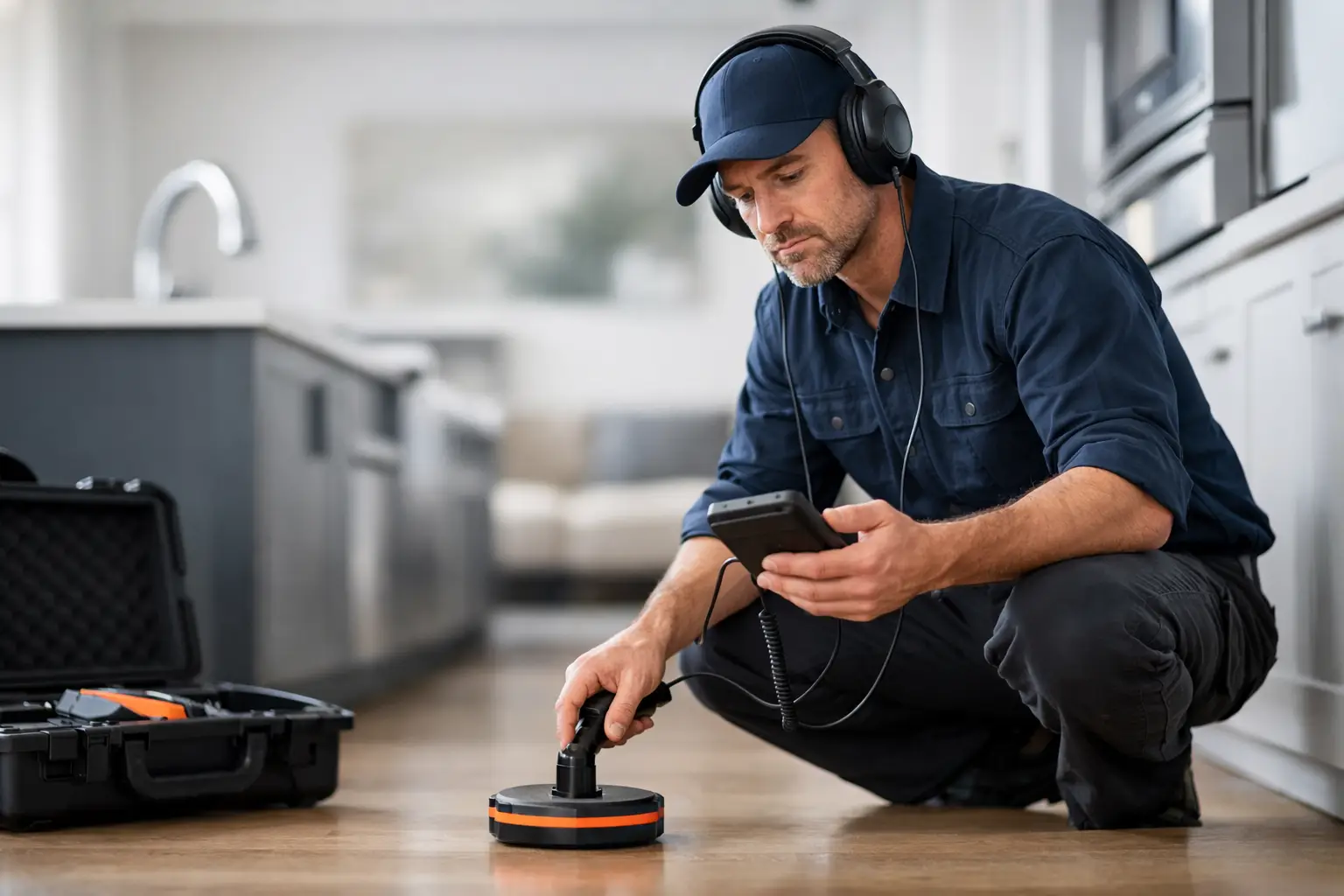
Acoustic leak detection listens for the sound signature produced by escaping water or gas under pressure. On suitable pipe materials and under the right site conditions, it can be very precise. The challenge is that noisy environments, deep pipe runs and low-pressure systems can reduce clarity.
Tracer gas testing is one of the most effective methods for concealed pipe leaks where conventional listening techniques are limited. A safe test gas is introduced into the isolated system, and highly sensitive equipment detects where it escapes. This is often particularly valuable beneath tiles, screed and external hardscape where demolition would otherwise be speculative.
Pressure testing confirms whether a system is losing integrity and helps separate active leakage from historic staining or unrelated moisture. On its own, it tells you a leak exists. Combined with location methods, it becomes a powerful way to validate findings before any opening-up works start.
Moisture mapping, dye testing and technical visual inspection also play an important role. Many leak investigations are solved not by a single dramatic reading but by a pattern of evidence built from several tests that support the same conclusion.
Where non-invasive leak detection performs best
It performs particularly well in concealed plumbing systems, bathroom and kitchen supply lines, underfloor pipe routes, irrigation networks, swimming pool systems, district cooling branches and many commercial water services. It is also highly effective where the cost of blind demolition is high, such as hotels, hospitals, schools, retail centres and occupied residential buildings.
In these settings, the value is not just the ability to find the leak. It is the ability to reduce repair scope. If you can narrow a problem from an entire bathroom to one pipe run beneath one section of floor, that changes the cost, the time on site and the disruption to occupants.
For facilities and industrial teams, the benefit is even broader. Accurate non-destructive diagnosis supports maintenance planning, protects finishes and allows the operation to stay online wherever possible. When shutdowns are expensive, precision is not a luxury. It is a control measure.
When accuracy is lower – and why
There are cases where results are less definitive. Intermittent leaks are one example. If a leak only presents under certain temperatures, occupancy patterns or weather conditions, the fault may not be fully active during inspection. That does not mean testing has failed, but it may mean staged investigation is needed.
Waterproofing failures can also be complex. Water can travel far from the entry point, especially on roofs, balconies, podium decks and wet areas. The visible damage inside the property may be metres away from the actual defect. In those cases, non-invasive testing can still narrow the cause, but sometimes controlled flood testing or selective opening-up is required to confirm the exact breach.
Older properties and heavily altered systems create another challenge. Unrecorded pipe reroutes, mixed materials, poor previous workmanship and multiple historic repairs can interfere with straightforward interpretation. A competent specialist will say when the evidence is strong, when it is probable, and when confirmation testing is still needed.
The real mistake: judging accuracy by gadget, not process
Clients often ask which device is most accurate. The better question is which process produces the most dependable result for this specific leak. A structured process usually looks at the property history, symptoms, system design, pressure behaviour, environmental conditions and test correlation. That is how false positives are reduced.
This is also why low-cost, rushed inspections often disappoint. If the objective is simply to wave a camera around and point at a damp patch, the client is left with a report that sounds technical but does not reduce repair risk. A proper investigation should help a contractor open the right area first, with a clear rationale behind it.
That approach is where specialist teams such as LeakDtech create real value. The aim is not to impress with equipment. It is to locate the fault with enough precision that the next action is confident, controlled and cost-effective.
What clients should expect from an accurate leak detection visit
An accurate visit should begin with questions, not demolition. When did the issue start? Is the water usage consistently high or intermittent? Does the pressure drop when fixtures are isolated? Is the damage linked to rainfall, tank refilling, HVAC demand or irrigation cycles? Those details shape the inspection strategy.
You should then expect method selection based on the type of system involved, followed by evidence gathering from more than one angle where necessary. In many cases, the strongest outcome is not just a suspected point but a documented diagnosis supported by readings, images and test results. That is especially important for landlords, insurers, facilities managers and commercial stakeholders who need accountability as well as speed.
No serious specialist should promise that every leak in every structure can be pinpointed to the millimetre without exception. What they should promise is disciplined testing, honest reporting and the minimum necessary disruption to reach a reliable answer.
Is non invasive leak detection accurate enough to trust before repairs?
In most cases, yes. It is accurate enough to guide repairs with far greater confidence than visual guesswork or broad demolition. The strongest results come when the leak is active, the right method is used, and the findings are cross-checked rather than assumed.
That matters because the real objective is not simply finding water. It is finding the source in a way that protects the property, limits downtime and stops money being wasted on the wrong repair. When the investigation is done properly, non-invasive leak detection is not just accurate enough. It is often the most commercially sensible place to start.
If you are dealing with a persistent leak, rising water costs or repeat repair failures, the smartest next step is not to open everything up and hope for the best. It is to get a precise diagnosis first and let the evidence decide where the repair should begin.