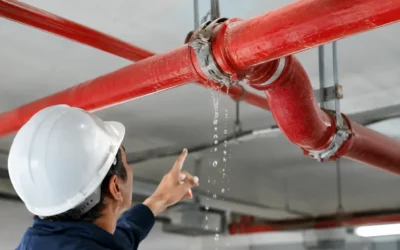
A tank can lose product, water or process fluid for months before a visible stain appears. By the time a site notices unexplained inventory variance, falling pressure, ground saturation or corrosion around a base ring, the cost may include lost stock, contaminated ground, production disruption and a difficult compliance question. Industrial tank leak testing provides the evidence needed to act early, isolate the fault accurately and avoid opening up or replacing assets unnecessarily.
For industrial and petrochemical operators, the objective is not simply to confirm whether a tank leaks. It is to establish where the loss is occurring, how serious it is, whether it is active under normal operating conditions and what repair route protects safe operation with the least possible interruption.
Why industrial tank leak testing needs a planned approach
An industrial tank is rarely a standalone asset. It connects to inlet and outlet lines, valves, flanges, level instruments, drainage points, overflow systems, bunds and foundations. A reported tank leak may actually originate at a buried pipe connection, a failed flange gasket, a compromised valve seal or a drainage pathway carrying liquid away from the true source.
This is why visual inspection alone is not enough. Surface corrosion can look alarming while remaining contained, whereas a pinhole defect beneath insulation, at a floor-to-shell junction or below grade may release significant volumes without obvious external signs. The right test programme combines inspection with methods suited to the tank’s construction, contents, operating pressure and access limitations.
The choice also depends on the consequence of failure. A potable-water holding tank, fire-water tank, chemical vessel and fuel storage tank present very different safety, environmental and operational risks. Testing must be proportionate. Over-testing can create avoidable downtime; under-testing leaves operators making expensive decisions on incomplete information.
What a competent test programme should establish
Before testing begins, the inspection team should agree the questions that matter commercially and technically. Is there confirmed product loss, or only a suspected loss? Does the issue occur continuously, only under pressure, or at a particular fill level? Is the tank safe to retain in service while investigations continue?
A useful industrial tank leak testing report should identify the tested asset and boundaries, test conditions, methods used, readings obtained, likely leak locations and clear recommendations. It should also distinguish observed facts from engineering judgement. That clarity helps facilities teams schedule work, support insurer discussions and demonstrate that the issue has been investigated responsibly.
Where a tank holds regulated or hazardous materials, the programme may need to address containment integrity, secondary containment, vapour risks and site permit requirements. No diagnostic benefit justifies bypassing isolation procedures, gas testing, confined-space controls or process safety rules.
Testing methods and where they fit
There is no single test that suits every tank. An effective investigation usually starts with the least intrusive method capable of narrowing the search area, then adds targeted testing where results justify it.
Visual inspection and condition assessment
A structured visual inspection examines shell plates, welds, roof penetrations, manways, nozzles, support interfaces, coating condition, floor-edge areas and nearby pipework. Inspectors also look for distorted plates, recurring corrosion, failed sealant, damp patches, salt deposits and unusual vegetation growth around external tanks.
Visual work is fast and valuable, but it has limits. It cannot confirm a hidden leak path or quantify a small loss rate on its own. Its main role is to guide the next diagnostic step and document visible defects before repair planning.
Pressure and level testing
Pressure testing can reveal whether a closed system holds stable pressure over a controlled period. It is particularly useful for associated pipework, connections and certain tank configurations. For open or vented tanks, monitored level testing may be more appropriate, provided evaporation, temperature movement, operational draw-off and replenishment are controlled or accounted for.
A pressure drop confirms that the system is not holding as expected, but it does not automatically identify the location. The result needs to be interpreted alongside isolation points, temperature changes and test duration. A poorly controlled test can create misleading readings and send maintenance teams towards the wrong repair.
Acoustic leak detection
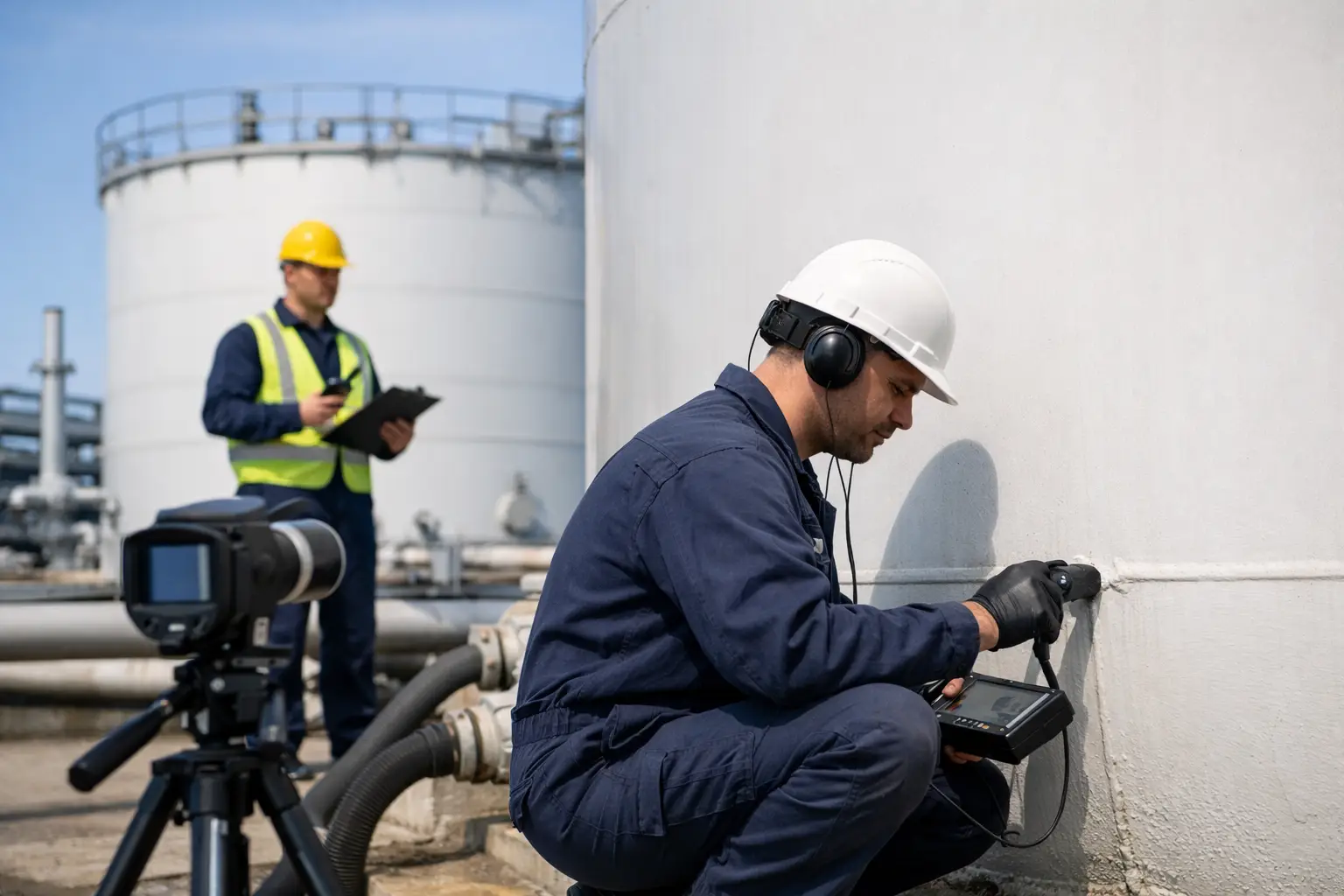
Acoustic equipment listens for the vibration produced as pressurised fluid escapes through a defect. It can be highly effective on pressurised lines connected to tanks and on accessible metallic components, especially when background plant noise can be managed.
Its effectiveness depends on pressure, material, pipe size, coating, burial depth and ambient noise. A busy plant with pumps, compressors and traffic may require testing during a quieter operating window or the use of advanced filtering and correlation techniques.
Thermal imaging
Thermal imaging identifies temperature differences that may indicate moisture movement, product loss, failed insulation or abnormal flow. It can be useful around tank shells, roofs, pipe penetrations and surrounding surfaces, particularly where a leaking liquid has a different temperature from the material around it.
Thermal imaging does not see through steel or concrete. It identifies thermal patterns, not leaks directly. Experienced interpretation matters because sunlight, weather, insulation defects and normal process temperature changes can produce similar signatures.
Tracer gas testing
Tracer gas testing is a precise option for difficult-to-locate leaks in isolated systems, double-contained sections and pipework where water-based tests are impractical. A safe, non-toxic tracer gas is introduced under controlled conditions, then specialist sensors are used to trace its escape point.
This approach can reduce unnecessary excavation and demolition, but it requires proper system isolation and a suitable testing boundary. It is not a substitute for understanding the tank process or verifying that all connected routes have been controlled.
Non-destructive testing for tank integrity
Where corrosion or wall-thickness loss is suspected, non-destructive testing can assess material condition without cutting into the tank. Ultrasonic thickness measurements, weld inspection and targeted examination of high-risk zones can show whether a defect is superficial, localised or part of broader deterioration.
For older assets, this information is often as valuable as the leak location itself. Finding and sealing one defect is not a long-term solution if the surrounding floor, shell or weld system has reached the end of its serviceable condition.
Common leak locations that are missed
Tank operators understandably focus on the shell, roof and visible fittings. Yet many persistent losses occur at interfaces: nozzle connections, manway gaskets, drain valves, level gauge penetrations, overflow lines and buried transfer pipework immediately beyond the tank boundary.
The tank floor deserves particular attention. A leak from the underside may be concealed by the foundation or base, while poor drainage can carry liquid away from the source. In a bunded area, rainwater management can further complicate the picture by masking contamination or changing observed liquid levels.
Another frequent issue is testing a tank when it is empty, then declaring it sound. Some faults only open under hydrostatic head, process temperature, vibration or a specific level of fill. Test conditions should reflect the conditions under which the suspected loss occurs, while remaining safe and approved by site operations.
Preparing for testing without creating unnecessary downtime
Good preparation protects both the result and the production schedule. Site teams should provide available drawings, previous inspection records, product data, recent maintenance history, level trends and details of abnormal consumption or inventory loss. Even incomplete records can reveal whether the problem follows a particular shift pattern, process cycle or fill level.
The inspection scope should define the tank, connected pipework and any sections to be isolated. This prevents the common problem of testing a broad system and receiving an inconclusive result because multiple lines, valves or replenishment routes remained connected.
Operational controls are equally important. Agree access requirements, permit-to-work conditions, isolation plans, cleaning needs and safe testing windows in advance. For critical fire-water, cooling-water or process assets, a phased plan may allow testing around operational demand rather than forcing a full shutdown.
Turning test findings into a cost-controlled repair plan
The most useful outcome is a prioritised decision, not a folder of readings. A minor external gasket leak may justify a planned repair during the next maintenance window. A floor integrity concern, an active hazardous-material release or evidence of foundation contamination demands a faster escalation.
Repair recommendations should account for leak severity, safety exposure, product value, corrosion extent, access, downtime and the likelihood of recurrence. Sometimes targeted sealing or component replacement is appropriate. In other cases, recurring failures indicate a wider integrity issue that needs coating renewal, floor repair, pipe replacement or a formal engineering assessment.
LeakDtech approaches tank investigations as an asset-protection exercise: locate the true failure path, document the evidence and help the site choose the least disruptive route to a dependable repair. This is particularly valuable in Dubai, where water loss, cooling demand and high-value operating assets can make a delayed diagnosis disproportionately expensive.
A suspected tank leak should not be left to become a visible emergency. Early, methodical testing gives operators the information to protect people, contain costs and plan repairs before a manageable defect becomes a shutdown.