
A damp patch appears beneath a bathroom wall. The ceiling below starts to stain, a villa’s DEWA bill rises without explanation, or pressure drops repeatedly on a fire line. Too often, the response is to open the nearest wall, replace a visible fitting and hope the problem disappears. Repair guessing versus technical diagnostics is the difference between spending once on a confirmed fault and paying repeatedly for disruption, reinstatement and repairs that never address the source.
For a homeowner, this may mean a ruined ceiling and another week of contractors in the property. For a hotel, school, hospital, mall or industrial operator, it can mean damaged finishes, lost rooms, safety exposure, interrupted operations and a difficult insurance conversation. The leak is only part of the cost. Uncertainty is what makes the event expensive.
Why repair guessing creates repeat failures
Repair guessing begins with an assumption: water is visible here, so the leak must be here. That assumption is frequently wrong. Water can travel along pipe insulation, concrete slabs, conduits, joints and wall cavities before it emerges. The point where staining appears may be metres from the actual failure.
A plumber may replace a valve because it is accessible. A contractor may regrout a shower because moisture is present around the enclosure. A maintenance team may seal a crack in a roof or wall because it looks suspicious. Any of these actions can be reasonable if supported by evidence. Without evidence, they are interventions based on probability rather than confirmation.
This approach sometimes appears cheaper at first. A small repair is authorised quickly, there is no diagnostic fee and the issue may look better for a few days. But the apparent saving disappears when the symptom returns. Each unsuccessful attempt adds labour, materials, access costs and reinstatement work. It can also mask the evidence needed to identify the original fault.
In occupied properties, the hidden cost is often disruption. Repeated tile removal, ceiling opening and drying works inconvenience residents and tenants. In commercial and industrial environments, unnecessary excavation or shutdowns can carry a far higher price than the leak repair itself.
Repair Guessing Versus Technical Diagnostics: the practical difference
Technical diagnostics starts with a different question. Not, “What can we replace quickly?” but, “What evidence proves the failure mechanism and its location?” The objective is to establish a defensible repair scope before destructive work begins.
A competent inspection considers the system as a whole: supply lines, drainage, waterproofing, fixtures, pressure behaviour, usage patterns and the construction assembly around them. It distinguishes between an active pipe leak, a drainage defect, a failed seal, condensation, rainwater ingress and residual moisture from an earlier event. These conditions can look similar on the surface but require entirely different repairs.
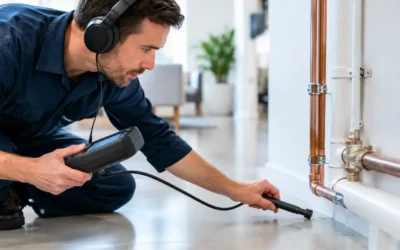
For example, thermal imaging can identify unusual temperature patterns associated with moisture or active flow, but it does not independently prove every leak. Acoustic equipment can listen for the sound created by pressurised water escaping from a pipe, yet background noise and pipe material affect results. Tracer gas can be highly effective for difficult concealed pipework, but the system must be properly isolated, tested and interpreted. Pressure testing confirms whether a closed system is losing pressure, though it does not always identify the precise location on its own.
The value comes from combining suitable methods, not relying blindly on one device. Technical diagnostics uses each result to narrow the possibilities until the repair location and likely failure type are clear. That is how non-invasive investigation reduces unnecessary demolition.
A visible symptom is not a diagnosis
A brown ceiling mark does not automatically mean a leaking pipe above it. It could originate from a shower trap, failed bathroom waterproofing, an air-conditioning condensate drain, roof ingress or a historic event that has already stopped. Treating every stain as a pipe leak wastes time and may create avoidable damage.
The same principle applies to high water consumption. An elevated bill can result from irrigation losses, concealed supply leaks, faulty float valves, pool equipment, leaking toilets or unusual consumption patterns. Meter checks and controlled isolation tests help determine whether the issue is continuous loss, demand-related usage or a meter and billing question.
Diagnostics should lead to a precise scope
The output of a proper investigation is not merely “a leak was found”. It should give the property stakeholder enough clarity to act: the affected system, the probable failure point, the test methods used, relevant readings, the recommended repair approach and any limitations. Clear reporting protects the client from vague quotations and helps facilities teams coordinate access, permits, reinstatement and follow-up verification.
For insurers, developers and asset managers, documented findings also establish a more reliable record of condition and causation. That matters when assessing defects liability periods, recurring claims or contractor accountability.
When a straightforward repair is appropriate
Not every issue needs a full technical investigation. If a mixer is visibly dripping, a toilet fill valve is clearly running or a pipe joint is exposed and actively leaking, a direct repair is sensible. The fault is evident, the repair point is accessible and verification is simple.
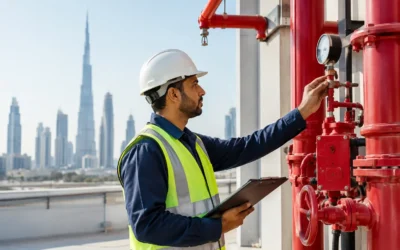
Diagnostics become essential when the source is concealed, the problem has returned after earlier work, water has travelled away from its origin, or opening the wrong area would be costly. They are equally important where systems are safety-critical or operationally sensitive, including fire networks, chilled-water lines, process pipework, tanks and district cooling infrastructure.
The decision should be proportionate to risk. Opening a small gypsum-board inspection panel in a low-risk location may be a practical first step. Breaking expensive stone finishes across several rooms without evidence is not. In a petrochemical or industrial setting, the threshold is even higher because access, safety controls and downtime materially change the cost of getting it wrong.
The financial case for finding the source first
Technical diagnostics has a cost, but it should be assessed against the total cost of uncertainty. That total includes failed repairs, demolition, drying, mould treatment, replacement finishes, lost revenue, tenant complaints, elevated water bills and potential damage to electrical or structural elements.
Consider a concealed leak beneath a tiled bathroom floor. Guessing may lead to removing tiles around the shower, replacing grout and resealing the tray. If the actual problem is a pressurised line running beneath the adjacent vanity, the property owner pays for two repair cycles and two reinstatement scopes. Accurate location may allow a targeted opening, one repair and a controlled moisture-drying plan.
For large portfolios, recurring leaks expose a separate problem: weak asset intelligence. Repeated reactive repairs do not reveal patterns in installation quality, ageing pipework, irrigation zones or waterproofing failures. Technical findings, recorded consistently, give community managers and facilities teams data they can use to prioritise preventive maintenance and capital works.
What an evidence-led process looks like
A reliable process starts with information gathering. Occupants and site teams are asked when the issue began, whether it changes with water use or weather, what repairs have already been attempted, and which systems are nearby. Previous photographs, bills and maintenance records can be useful, but they are not treated as proof.
The inspection then moves from non-invasive checks towards targeted testing. This may include moisture mapping, thermal imaging, acoustic tracing, pressure tests, drain tests, tracer gas testing or controlled isolation of individual zones. The exact combination depends on the building construction, pipe material, accessibility and suspected failure type.
Only once the evidence points to a location should opening-up work be recommended. After repair, retesting is equally important. A repaired fitting may look satisfactory while another defect remains in the system. Verification confirms whether pressure has stabilised, acoustic signatures have ceased, moisture is reducing or drainage is performing as expected.
LeakDtech applies this engineering-led approach to hidden water failures because a clean, accurate diagnosis protects both the property and the repair budget. The aim is not to use every test available. It is to use the right method, in the right sequence, to reach a practical answer quickly.
Questions to ask before approving repair work
Before authorising invasive repairs, ask the contractor what evidence identifies the source, not just the affected area. Ask whether the supply line, drainage system and waterproofing have been distinguished from one another. Ask how the repair will be verified once complete, and whether the proposed opening is the minimum required to access the fault.
For facilities managers, add operational questions: Does the work require isolation? What is the shutdown risk? Can testing be completed outside peak hours? Is a report needed for the client, insurer or developer? These questions turn a reactive maintenance task into a controlled property-protection decision.
The right repair is rarely the fastest-looking repair. It is the repair supported by enough evidence to stop the failure, limit damage and avoid returning to the same problem a few weeks later.