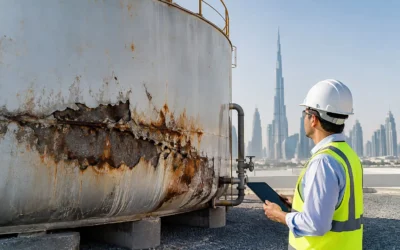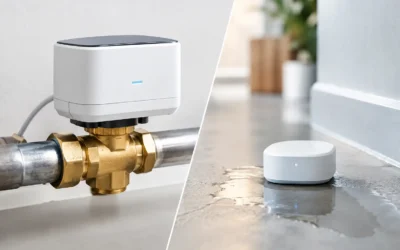

A fire line can lose water for months without producing an obvious puddle, yet the consequences appear quickly when a hydrant, hose reel or sprinkler connection is needed. Dubai fire line testing gives property owners and facilities teams evidence of whether the pipework is holding pressure, delivering the required supply and remaining fit for service without unnecessary excavation.
For a villa community, hotel, warehouse, school or industrial facility, a suspected fire-line leak is not a routine plumbing issue. It can affect life-safety systems, create excessive water consumption, damage landscaped areas or roads, and expose a site to expensive remedial works. The right test programme identifies the actual condition of the line before repairs are planned.
What Dubai fire line testing is designed to find
Fire lines are dedicated pipe networks that carry water to firefighting equipment. Depending on the site, this may include underground mains, hydrant loops, fire pump connections, hose reels, landing valves, sprinkler supplies and sectional isolation valves. Many of these assets are concealed below ground, behind finishes or within service corridors, where deterioration can continue unnoticed.
Testing is used to investigate pressure loss, verify the integrity of a repaired section, support handover and quality assurance, or establish the condition of an ageing network. It is particularly valuable where a pump repeatedly cycles, make-up water use is unexplained, ground remains persistently wet, or pressure drops after isolation.
A well-planned assessment may reveal a pinhole corrosion leak, a failed mechanical coupling, a damaged valve seal, poor jointing, pipe movement, third-party damage or a connection that was never properly capped. The visible symptom is often the same – falling pressure. The underlying cause can be very different, which is why guessing and excavating at random is expensive.
Why pressure loss needs a technical investigation
A pressure gauge can confirm that a problem exists, but it cannot tell you where water is escaping. Nor can it distinguish between a leak, a passing valve, thermal movement, a test-set-up issue or a connected component that has not been isolated correctly.
The first task is to understand the network. Engineers should establish the line layout, material, age, known modifications, valve positions and active connections. On complex sites, this includes defining whether the loss sits within the incoming fire-water supply, a ring main, a branch serving equipment or a pump-room component.
This matters because indiscriminate pressure testing can create operational risk. Fire protection cannot simply be taken out of service because a contractor wants access. Any isolation, impairment or testing arrangement must be controlled with the building management team and the relevant fire-safety procedures. In occupied premises, temporary precautions and clear communication are essential.
The testing pressure, duration and acceptance criteria also depend on the system type, the purpose of the test and the applicable project specification or authority requirements. A blanket test method is not engineering. The programme must match the asset being assessed.
How a targeted fire-line test is carried out
The most effective approach combines conventional integrity testing with non-invasive diagnostic methods. This reduces disruption and helps avoid opening roads, paving or landscaped areas before there is defensible evidence of the leak location.
Establish the test boundary
The line is divided into manageable sections using confirmed isolation points. This prevents a large network from producing vague results and helps narrow a loss to a specific zone. Technicians verify that valves are holding, dead legs are understood and connected equipment is protected before introducing test pressure.
Where drawings are incomplete, the investigation may also involve site tracing, valve chamber checks and physical verification of pipe routes. Existing drawings are useful, but they should never be treated as proof of what was installed or altered over time.
Monitor pressure and water behaviour
A controlled pressure test is performed using calibrated equipment. Pressure is monitored over the agreed period, with ambient conditions and test conditions recorded. A meaningful result depends on stable set-up, correct venting, reliable gauges and a properly isolated test section.
If pressure falls, the team assesses whether the pattern indicates a genuine leak. Sudden loss can suggest a significant opening or valve issue. Gradual loss may point to a smaller leak, a weak joint or a component passing internally. The data guides the next diagnostic step rather than automatically triggering excavation.
Pinpoint the source before digging
For buried fire lines, acoustic listening equipment can detect the sound created by water escaping under pressure. Correlating sensors placed at separate access points can help calculate the likely position of a leak along the pipe route.
Tracer gas testing can be useful where acoustic signals are weak, pipe materials dampen sound, the leak is small or the environment is noisy. A safe tracer gas mixture is introduced into an isolated test section, then specialised sensors detect where it migrates towards the surface. Thermal imaging may also support investigations where escaping water creates a detectable temperature difference, although its effectiveness depends on depth, surface materials, weather and operating conditions.
No single technique is right for every site. A deep main under reinforced concrete may require a different strategy from a shallow HDPE irrigation-adjacent line beneath paving. The benefit comes from selecting methods based on pipe material, depth, access, pressure and the consequences of disruption.
Where fire-line failures create the greatest cost
The direct cost of water is only part of the problem. An underground leak may soften soil beneath hardstanding, undermine interlock paving, damage landscaped areas or create recurring dampness around building perimeters. In commercial environments, unplanned excavation can restrict vehicle movements, affect customer access and disrupt tenants.
For facilities managers, repeated pressure-loss alarms can consume maintenance time and create uncertainty around system readiness. For developers, an unresolved defect before handover can become a difficult DLP issue, particularly when surfaces have already been completed. For hospitality, healthcare and education sites, intrusive work during operating hours may be far more costly than the repair itself.
A precise investigation changes the repair scope. Instead of opening a long trench on assumption, the contractor can target a verified zone, expose the pipe once, repair the failure and retest the affected section. That protects budgets, reduces reinstatement works and shortens the period of impairment.
Testing after repairs is not optional
A repair that appears dry at the surface is not necessarily proven. Every completed repair should be followed by a documented integrity test appropriate to the section and project requirements. This confirms that the repaired point holds and that no additional weakness is masked elsewhere in the isolated line.
Documentation should record the test boundary, equipment used, test conditions, starting and ending readings, observed findings, diagnostic location data, repair details and final outcome. For asset owners, this creates a useful maintenance record. For consultants, insurers and project teams, it provides technical evidence that decisions were based on measured results rather than assumptions.
LeakDtech approaches suspected fire-line losses as an asset-protection issue, using pressure testing and non-destructive diagnostic methods to identify the source with minimum disruption. The objective is not merely to confirm that water is being lost. It is to give the client a clear repair location, reliable test data and a practical route back to service.
When to arrange a fire-line assessment
Do not wait for visible flooding. Investigation is justified when fire-pump pressure will not stabilise, water use rises without explanation, hydrant zones repeatedly lose pressure, damp patches return after repairs, or a new installation needs an independent quality check. Testing is also sensible before major resurfacing or refurbishment, when future access to buried pipework will become more difficult and expensive.
The most valuable result is certainty before the site is opened up. A controlled test and accurate leak location allow property teams to protect firefighting readiness while directing repair budgets to the exact part of the network that needs attention.