
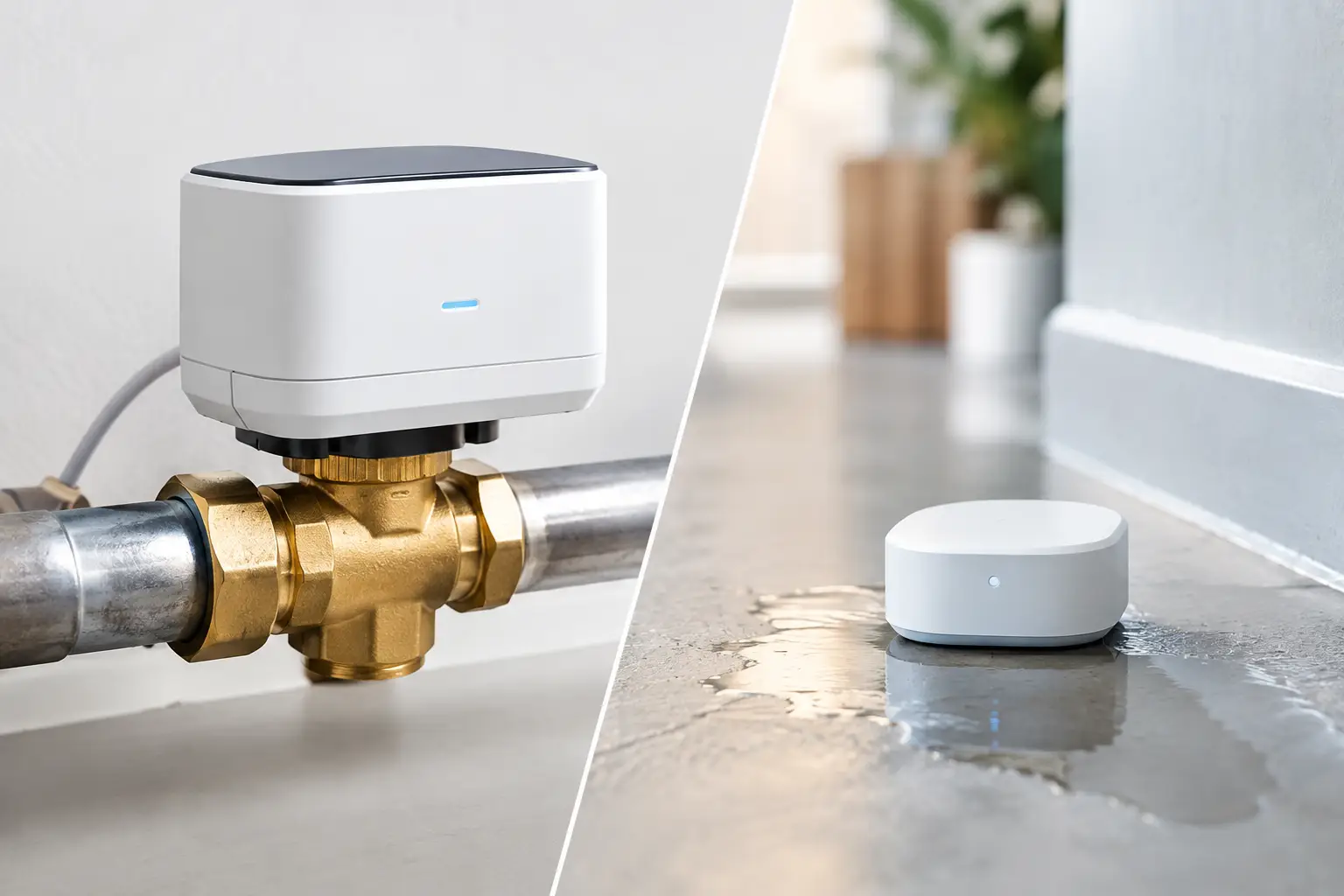
A burst flexi hose beneath a basin can release hundreds of litres before anyone notices. A slow concealed leak may do less obvious damage but can quietly inflate a DEWA bill, weaken finishes and encourage mould. The smart valve versus leak sensor decision is therefore not about choosing the newest gadget. It is about deciding how quickly your property needs to move from warning to protection.
For villa owners, landlords and facilities teams, both technologies have a place. They solve different parts of the same risk: unwanted water escaping where it should not. The right choice depends on the water system, the value of the asset, whether the property is occupied, and the consequences of a false alarm or missed event.
Smart valve versus leak sensor: the essential difference
A leak sensor is an alerting device. It is placed where water is likely to appear first, such as under a sink, beside a water heater, behind a washing machine, beneath an FCU drain pan or within a plant room. When its contacts detect water, it sounds an alarm and may send a notification to a mobile phone or building management platform.
A smart valve is a control device installed on the incoming water supply. It continuously monitors flow, pressure and, depending on the system, usage patterns. When it identifies flow consistent with a significant leak, it can notify the owner and automatically close the water supply.
That distinction matters. A sensor tells you that water has reached a particular location. A smart valve can limit how long water continues to flow. One provides local confirmation; the other provides system-wide intervention.
Neither should be treated as a replacement for professional diagnosis when there is unexplained consumption, recurring dampness, pressure loss or visible damage. Technology can reduce the consequences of a failure. It does not repair failed pipework, defective waterproofing or poor drainage.
Where a leak sensor is the better choice
A leak sensor works well where the risk is concentrated and predictable. Think of a dishwasher connection in a tenanted flat, a washing machine cabinet, an under-sink filtration unit or a chilled-water condensate tray. These are points where even a small amount of water is meaningful, but shutting off the whole property supply may be disproportionate.
They are also useful where targeted detection is needed around equipment that is not served by the domestic potable water line. A sensor can identify a condensate overflow, for example, even though a main water shut-off valve cannot stop it.
The attraction is straightforward: sensors are generally quick to deploy and comparatively inexpensive. Property managers can add them to high-risk locations during handover inspections or refurbishment works without altering the incoming supply pipe. For an occupied home, they offer reassurance around appliances that are frequently left unattended.
The trade-off is coverage. A sensor only detects water where it has been installed. If a pipe leaks inside a wall, beneath a tiled floor, in a ceiling void or at the other end of a villa, the sensor may never see it. It also relies on someone responding to the alarm. If the alert arrives while the owner is travelling, water can continue running until access is arranged.
Battery condition, wireless signal strength and placement also affect performance. A sensor positioned too far from the likely leak path is not protection. It is simply an alarm waiting in the wrong place.
When a smart valve earns its cost
A smart valve is most valuable when continuous water flow could cause major loss before a person can intervene. This includes vacant villas, holiday homes, landlord-owned properties between tenancies, premium residences, retail units, offices and sites with a history of supply-side failures.
Because the valve sits at the incoming water line, it can respond to a leak behind finishes or in a remote bathroom, rather than waiting for water to reach a detector. It is particularly effective against sudden pressurised failures such as a burst flexible connector, a damaged supply hose or an open pipe caused by accidental impact.
A properly installed system also creates visibility. Owners can review consumption trends, receive alerts when unusual flow is detected and remotely manage the water supply. That operational control is useful in Dubai, where an unoccupied property can remain unattended during long periods of travel and extreme heat places additional demands on building services.
AquaSentra Smart Water Management, for example, combines 24/7 flow and pressure monitoring with automatic shut-off. For AED 1,999 supplied and installed, it is often easier to justify than the cost of repairing damaged cabinetry, ceilings, flooring and electrical finishes after a single uncontrolled leak.
Yet a smart valve is not automatically right for every building. It requires a suitable installation point, reliable connectivity and a clear understanding of the property’s normal water use. Irrigation cycles, pool top-ups, water treatment equipment, booster pumps and staff accommodation can create legitimate long-duration flow. If the system is not configured around those patterns, nuisance shut-offs can disrupt operations.
For commercial and industrial sites, the stakes are higher. Closing a water line without considering fire systems, process requirements, cooling equipment or critical hygiene services could create a separate operational problem. These environments need a site-specific assessment, defined alarm logic and an escalation procedure rather than a domestic off-the-shelf approach.
Detection speed is not the only measure
It is tempting to judge both options by how quickly they react. In practice, the more useful question is: what happens after detection?
A floor sensor may react instantly when water touches it, but it cannot prevent a concealed leak from continuing elsewhere. A smart valve can stop supply rapidly, but it may need a period of abnormal flow to distinguish a genuine event from normal usage. Some failures are also pressure-related or intermittent, making a combined approach sensible.
Consider a washing machine hose rupture. A sensor beside the appliance can provide immediate local confirmation, while a smart valve shuts off the source. In a plant room, strategically positioned sensors may identify the exact area affected, while a valve reduces the volume released. This combination improves both containment and diagnosis.
By contrast, if your concern is moisture entering through a roof, failed bathroom waterproofing or a leaking AC condensate drain, neither a main smart valve nor a domestic leak sensor alone addresses the root cause. Those failures require inspection, moisture assessment and targeted testing to identify the water pathway without opening sound finishes unnecessarily.
Installation and maintenance considerations
A leak sensor can often be installed in minutes, but it still needs planning. Place it at the lowest practical point, close to valves, hoses, appliance trays or drain pans. Avoid positioning it where routine cleaning, splashing or condensation will create repeated false alarms. Test the alarm and notification route after installation, not just the device itself.
A smart valve should be fitted by a competent technician who understands the property’s plumbing layout, isolation valves and water-consuming equipment. The installation should remain accessible for maintenance and manual operation. Before commissioning, check flow direction, pressure limits, Wi-Fi or network coverage and the availability of electrical power or battery backup where required.
For both systems, maintenance is modest but necessary. Test alerts periodically, replace batteries before they fail, keep firmware current where applicable and review notification contacts after staff or tenancy changes. A security guard receiving an alert without authority to enter the unit is not an effective response plan.
Choosing by property type
For a typical owner-occupied flat, a few well-placed sensors may be a sensible first step, especially around kitchens, utility cupboards and water heaters. If the flat is often empty, a smart valve offers stronger protection against a major supply-side event.
For villas, the case for a smart valve is usually stronger. Multiple bathrooms, external kitchens, irrigation, pool equipment and larger pipe runs create more opportunities for failure outside the owner’s immediate view. Sensors can then be added to specific high-risk zones rather than relied upon as the whole strategy.
For landlords and community managers, remote visibility and documented alerts can reduce response times and protect common areas below a leaking unit. However, access arrangements, tenant communication and approved shut-off procedures should be agreed before an emergency occurs.
For hotels, hospitals, malls, schools and industrial facilities, the decision should follow a water-risk review. Identify critical lines, vulnerable assets, consequences of isolation and existing BMS capabilities. In these settings, enterprise leak detection, zoned isolation and technical inspection may be more appropriate than a single domestic valve.
Do not use either device to mask a known problem
If water consumption remains unusually high, pressure drops without explanation, paint blisters return after repairs or mould keeps reappearing, treat the cause as unresolved. Installing monitoring equipment can provide useful evidence, but it should sit alongside accurate leak detection.
Non-invasive methods such as acoustic testing, thermal imaging, tracer gas and pressure testing help locate concealed failures without speculative demolition. This protects budgets and avoids the familiar cycle of breaking tiles, replacing a visible fitting and discovering that the actual leak was elsewhere.
The best protection is proportionate: use sensors to watch known vulnerable points, use a smart valve where automatic isolation can prevent significant loss, and investigate persistent symptoms before they become a refurbishment claim. A small decision at the water entry point can be the difference between a notification on your mobile phone and a costly recovery programme.