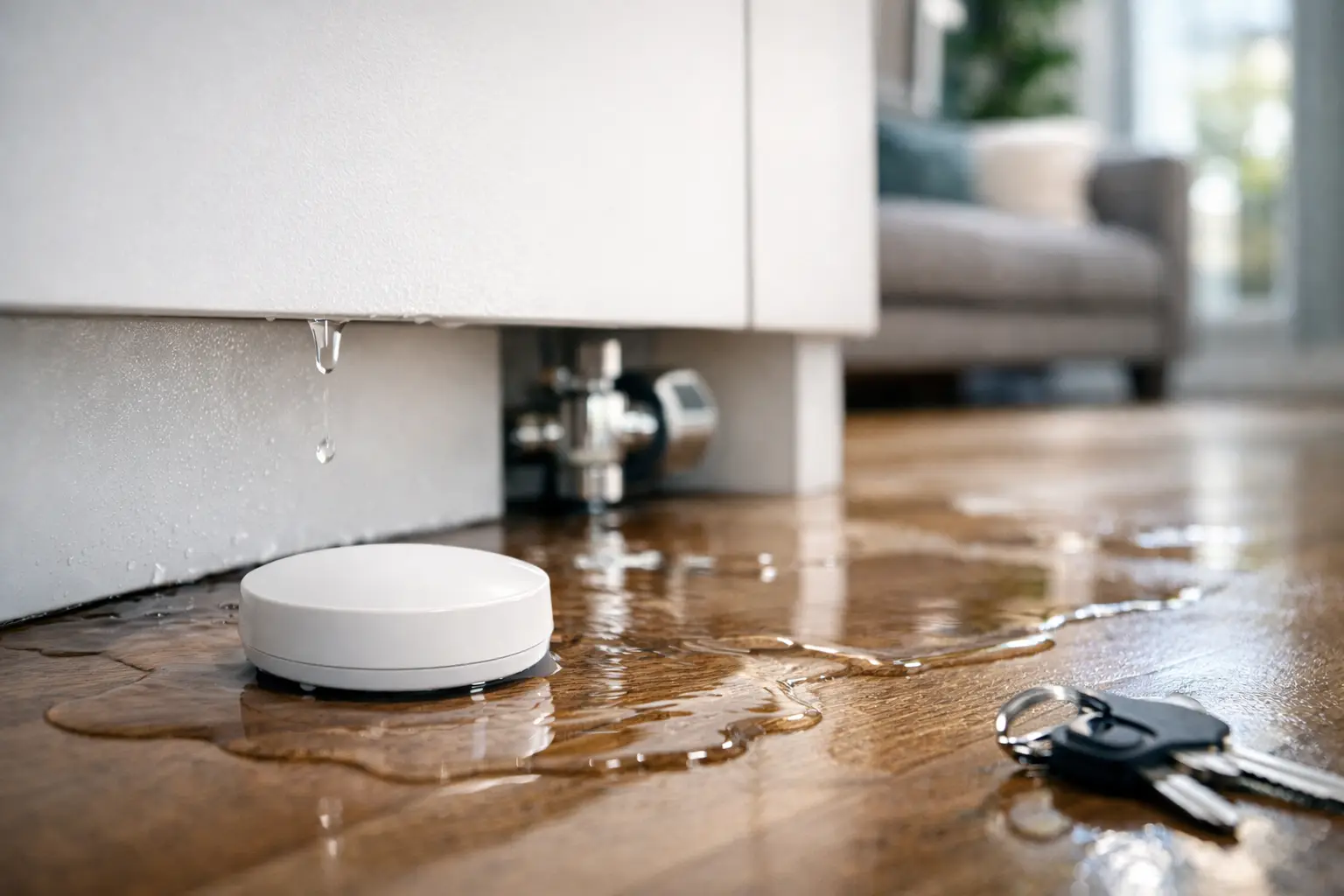
A washing-machine hose fails at 2am. Water runs beneath the utility cabinet, crosses the floor finish and reaches the flat below before anyone wakes up. Flat leak sensors can turn that costly, disruptive event into an early alert, but only when they are correctly selected, positioned and supported by a clear response plan.
For owners, landlords and facilities teams, the value is not simply receiving a notification. It is reducing water damage, avoiding claims, protecting finishes and preventing a small plumbing failure from becoming a multi-unit repair project. In high-rise buildings, where a leak can affect several occupiers and common areas, early action has a direct financial benefit.
What flat leak sensors actually do
Most flat leak sensors are small devices placed in areas where water should never collect. Their conductive contacts detect moisture on the floor or within a drip tray, then activate an audible alarm, send an app notification or communicate with a wider building-management system.
More advanced arrangements monitor water flow, pressure or continuous consumption. These systems can identify patterns that suggest a leak, such as water use when the property is vacant, and may close an automatic shut-off valve before significant damage occurs. The distinction matters. A floor sensor tells you that water has reached its location. A flow-monitoring system may detect a developing problem before water appears on the floor.
Neither approach is a substitute for sound plumbing installation, regular inspection or professional diagnosis. Sensors reduce the time between failure and response. They do not repair corroded pipework, failed waterproofing, cracked grout lines or leaks concealed inside walls and ceilings.
Where leak sensors deliver the strongest return
The best locations are not necessarily the most obvious ones. A sensor needs to sit at the likely first point of water escape, rather than in a convenient but distant corner. In a typical flat, the priority is beneath washing machines, dishwashers, kitchen sinks, water heaters, filtration units and air-conditioning drain connections.
Bathrooms deserve more judgement. A sensor beside a vanity or beneath a concealed cistern can be valuable, but it will not reliably reveal a shower waterproofing failure behind tiled finishes. Water may travel through screed, service voids or slab penetrations before becoming visible elsewhere. The same limitation applies to leaks from pipes running behind kitchen units or above false ceilings.
For landlords managing vacant units, sensors are particularly useful around water heaters, appliance connections and under-sink pipework. A vacant property can leak for days without a visible warning sign. For community managers, sensor programmes work best when they are paired with clear occupant communication, scheduled battery checks and a defined escalation route.
High-risk points to prioritise
Start with water sources that combine pressure, hidden connections and a high likelihood of failure. Washing-machine supply hoses, flexible tap connectors, heater valves and reverse-osmosis systems are frequent candidates. Also consider chilled-water fan coil units and condensate drain lines in Dubai flats, where air-conditioning operation is constant for much of the year.
A sensor placed beneath a unit is useful only if water can reach it. Cabinets with raised bases, uneven floors, deep trays or multiple compartments may require more than one device. Before installation, test the expected water path with a small controlled amount of clean water and confirm that the alarm can be heard or received by the responsible person.
Standalone alarms versus smart shut-off systems
A simple battery-operated floor alarm is inexpensive and quick to deploy. It suits a resident who is usually present and wants a warning near a single appliance. Its weaknesses are equally clear: it depends on someone hearing the alarm or noticing the alert, and it cannot stop the water supply.
Wi-Fi-enabled sensors offer remote notifications and are better suited to second homes, tenanted flats and portfolios. Their performance depends on stable connectivity, app permissions and maintained batteries. A notification that reaches an unavailable phone is not a response strategy.
Smart water-management systems add a further layer by tracking flow and pressure and, where configured, shutting off water automatically. This can be a strong fit for unoccupied properties or buildings with a history of escape-of-water incidents. AquaSentra Smart Water Management, for example, combines 24/7 monitoring with automatic shut-off capability, making it relevant where response time matters more than another audible alarm.
The trade-off is installation complexity. A smart valve needs a suitable location on the incoming water line, reliable power or battery provision, correct configuration and consideration of systems that must not be interrupted. Facilities teams should assess fire protection, domestic booster arrangements, irrigation feeds and any shared supplies before specifying automatic isolation. Shutting off the wrong line can create an operational issue of its own.
What sensors will not find
A common mistake is to install sensors after a leak and assume the root cause is controlled. Sensors are an early-warning measure, not a diagnostic method. They do not pinpoint a leak in a buried pipe, identify a failed membrane beneath tiles or prove the integrity of a district-cooling, chilled-water or drainage line.
They can also miss slow leaks that evaporate, drain into a wall cavity or travel away from the sensor. A high water bill, recurring damp patch, mould growth, bubbling paint or unexplained drop in water pressure requires investigation even when no sensor has activated.
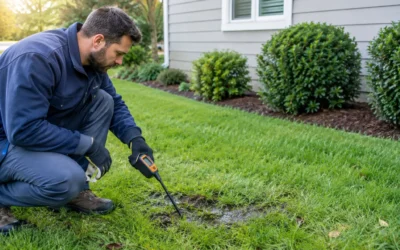
This is where non-destructive testing has a different role. Thermal imaging can identify abnormal temperature patterns linked to moisture or leaking services. Acoustic methods help locate pressurised water leaks. Pressure testing, tracer gas and moisture measurement provide further evidence when the source is concealed. The appropriate method depends on the pipe material, access, building layout and whether the system is pressurised.
Build a response plan before the alert arrives
A sensor installation succeeds or fails in the minutes after an alert. Residents should know where the local isolation valve is and whether it is safe to close. Landlords need an authorised contact who can gain access, isolate the supply and arrange inspection. Property managers should document which flat, sensor zone and system have generated the alarm.
For managed buildings, record sensor locations on the unit handover file and inspect them during planned maintenance. Replace batteries to the manufacturer’s schedule, check wireless connection status and test alerts after any router, app or occupancy change. Sensors that are installed and forgotten create false confidence.
It is also worth agreeing what happens after a genuine event. Water should be isolated first, but drying and source identification should follow promptly. Simply mopping up the visible water and reopening the supply can leave moisture inside joinery, floor finishes or wall cavities. That is how odour, mould and repeated damage begin.
Choosing the right level of protection
There is no single best system for every flat. A resident in an occupied one-bedroom flat may need a few well-positioned audible or Wi-Fi sensors. A landlord with several vacant properties may justify remote alerts and automatic shut-off. A facilities manager responsible for a tower needs a standardised specification, maintenance process and escalation framework that works across different occupancy patterns.
The decision should be based on the cost of failure, not only the price of the device. Consider the condition of the plumbing, the value of finishes below and around likely leak points, occupancy, past claims, response times and whether a leak could affect neighbouring units. A modest sensor investment can be highly effective when it addresses a known risk. It is less effective when used to mask unresolved defects.
When there are signs of an active hidden leak, do not wait for a sensor alert to confirm it. LeakDtech can investigate with targeted, non-invasive methods so repairs are based on evidence rather than demolition and guesswork. The practical goal is simple: use sensors to shorten the time to action, and use proper diagnostics to make sure the action fixes the real problem.