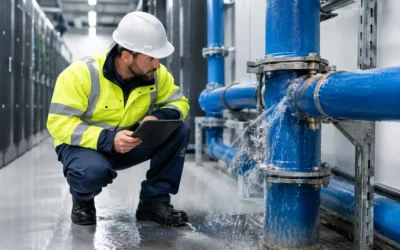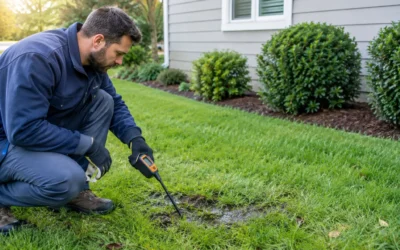
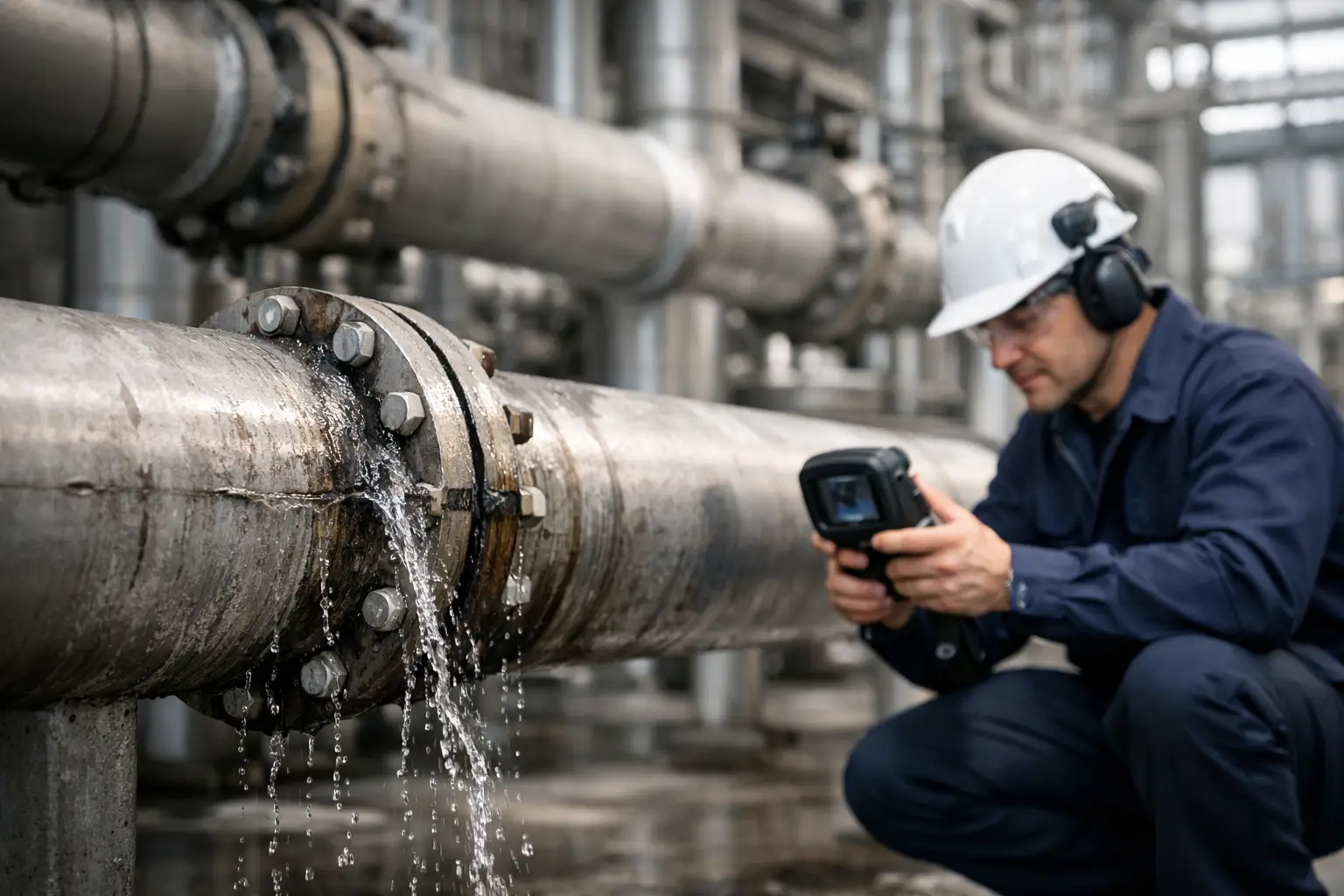
A pressure drop on a process line, an unexplained rise in make-up water, or recurring moisture near a plant room is rarely a minor maintenance issue. An industrial pipe leak survey turns those warning signs into evidence, locating the fault before it becomes a production interruption, safety concern, major water loss or costly excavation project.
For industrial facilities, the question is not simply whether a pipe is leaking. It is where the leak sits, how quickly it is developing, what system it affects and whether the line can remain operational while a repair is planned. A precise survey provides the technical certainty needed to make that decision.
Why industrial leaks are expensive to ignore
Industrial pipework operates under conditions that make leaks difficult and costly to manage. Lines may run below concrete slabs, through pipe racks, inside service corridors, beneath landscaped areas or alongside other utilities. A visible wet patch can be metres away from the actual defect, particularly where water follows ducts, joints or changes in ground level.
The direct cost is often only the starting point. Losses can include wasted treated water, higher utility consumption, reduced system pressure, equipment corrosion, contamination risk and damage to finishes or structural elements. In chilled-water, fire-fighting, irrigation, process-water and district cooling networks, a small loss can also affect performance across a much larger system.
For facilities managers and industrial operators, unplanned shutdowns are usually the largest exposure. Opening floors or excavating on assumption can disrupt operations without resolving the fault. A properly scoped survey reduces this risk by narrowing the repair area before invasive work begins.
What an industrial pipe leak survey should establish
A survey is not a single tool applied to every pipe. It is a methodical investigation that combines system information, field observations and suitable test technology. The objective is to establish whether there is an active leak, identify its likely location and provide a defensible basis for repair.
A useful report should record the system tested, line material and accessible route, test conditions, pressure readings, survey methodology, findings and recommended next actions. This documentation is valuable for maintenance planning, contractor coordination, insurance discussions and quality assurance records.
The most effective surveys also distinguish between a pipe leak and other sources of moisture. Condensation, failed waterproofing, defective drainage, valve seepage and infiltration can produce similar symptoms. Treating every damp area as a pressurised pipe failure leads to wasted repairs.
Start with system history and isolation
Before instruments are deployed, the survey team needs to understand the network. This includes pipe drawings where available, recent repairs, normal operating pressures, water consumption trends, valve locations and the times when the system is active.
Isolation testing is often the first decisive step. By shutting off sections of a network and monitoring pressure or flow behaviour, technicians can determine which zone contains the loss. On a large site, this prevents time being spent investigating pipework that is performing normally.
The approach must be planned carefully. Isolating a fire line, critical cooling circuit or process supply without operational approval may create more risk than the survey is intended to remove. The testing sequence should therefore align with permit requirements, site safety rules and production constraints.
Match the detection method to the pipe and environment
Acoustic leak detection is highly effective when pressurised water escaping through a defect creates a detectable sound or vibration. Sensitive sensors can trace that sound along accessible pipe routes, valves, hydrants and fittings. However, acoustic results can be affected by deep burial, low operating pressure, plastic pipework, heavy machinery noise and highly saturated ground.
Thermal imaging can reveal abnormal temperature patterns associated with leaking hot-water, chilled-water or process lines. It is particularly useful for identifying moisture spread and inspecting accessible services. It does not see through walls or concrete, so thermal evidence must be interpreted alongside moisture readings, system data and physical conditions.
Tracer gas testing is often selected where pipe routes are concealed, acoustic signals are weak or the line is non-metallic. A safe trace gas is introduced into an isolated and suitably prepared line, then detected above the surface as it escapes through a defect. This can provide exceptional localisation accuracy, but it requires the correct test conditions and competent control of the system.
Pressure testing confirms whether a section can hold pressure over a defined period. It is a valuable verification tool, although it does not independently identify the exact leak point. In many cases, pressure testing establishes the problem, while acoustic or tracer gas methods pinpoint it.
For complex assets, technicians may use several methods in sequence rather than relying on a single result. This is not duplication. It is how uncertainty is reduced before repairs are authorised.
The industrial pipe leak survey process
A disciplined survey begins with a site assessment. The technician reviews the reported issue, checks safety access, identifies services and agrees operational restrictions with the site representative. In a petrochemical, manufacturing or high-risk environment, this may include permits, gas testing, access control and coordination with the control room.
The system is then assessed under meaningful conditions. Testing a line that is empty, isolated incorrectly or operating at an unrepresentative pressure can produce misleading findings. Where possible, survey conditions should reflect the line’s normal duty while remaining safe for all personnel and equipment.
Technicians work from broad confirmation to focused localisation. They may assess consumption and pressure behaviour, divide the network into test zones, survey accessible routes and compare findings across different instruments. The aim is not to produce an impressive collection of readings. It is to identify a repair location with enough confidence to avoid unnecessary opening-up work.
Once the probable leak area is identified, the result should be marked clearly on site and supported by photographs, test data and a written explanation. If the evidence points to multiple defects, a staged repair plan may be more practical than treating the network as one isolated failure.
Common applications across industrial sites
Industrial leak surveys are relevant wherever water, cooling media or process fluids are transported through concealed or difficult-to-access lines. Typical applications include:
- fire-fighting ring mains and hydrant networks
- chilled-water and district cooling pipework
- process-water, washdown and utility lines
- irrigation mains across large sites and landscaped assets
- underground potable-water distribution networks
- tank connections, transfer lines and service corridors
Each application has different tolerances for downtime and different failure consequences. A leak in an irrigation main may be scheduled around site activity. A pressure loss in a fire line may require immediate investigation, escalation and compliance-focused documentation. The survey scope should reflect that difference.
When a survey is more urgent than it appears
Some indicators justify rapid attendance even when no surface damage is visible. These include persistent pressure loss, unexplained pump cycling, a sudden increase in consumption, recurring repairs in the same zone, soft ground near buried services, corrosion around pipe supports or unexplained water entering pits and chambers.
In Dubai, high ambient temperatures and continuously operating cooling systems can make water loss harder to interpret. Moisture may evaporate quickly at the surface, while concealed leakage continues below ground or within building services. Early investigation can prevent settlement, damage to insulation, corrosion of adjacent assets and disruption to occupied facilities.
A survey is also valuable after refurbishment, new pipe installation or major maintenance works. Testing and documenting the network before handover provides a baseline and can expose workmanship defects while responsibility is still clear.
Choosing the right survey partner
The lowest survey price can become expensive if it delivers only a vague statement that a leak is “somewhere on site”. Industrial clients need technicians who understand pipe systems, test limitations and the commercial impact of false excavation.
Ask whether the provider can work with your operating constraints, use more than one detection method where evidence requires it, and issue a clear technical report. Experience with industrial safety procedures, confined service areas, live facilities and sensitive infrastructure matters as much as the equipment itself.
LeakDtech approaches difficult leak investigations with non-invasive diagnostic methods designed to protect operations and reduce avoidable repair costs. The priority is clear: locate the fault accurately, provide evidence for action and help the site return to controlled operation with minimal disruption.
A well-timed survey does more than find a leak. It gives maintenance teams the confidence to repair the right section, at the right time, before a manageable defect becomes an operational event.