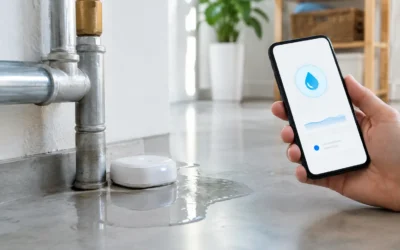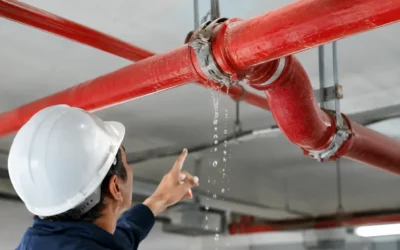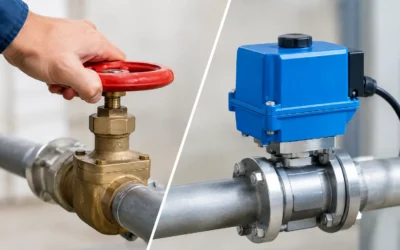

The problem with hidden leaks is not just the water you can see. It is the soaked screed under a tiled floor, the pressure loss in a line that feeds critical services, the mould growth behind joinery, and the repair bill that climbs every day the source remains unknown. A non destructive leak survey is designed to find that source accurately without turning diagnosis into demolition.
For homeowners, that usually means avoiding unnecessary tile breaking, repainting, and weeks of disruption. For facilities managers, hotels, schools, hospitals, and industrial operators, it means something more serious – protecting continuity, controlling liability, and preventing a small failure from becoming a shutdown event.
What a non destructive leak survey actually involves
A non destructive leak survey is not one single test. It is a structured diagnostic process that uses non-invasive methods to narrow down, confirm, and pinpoint the leak location with evidence. The right method depends on the asset, the pipe material, the operating pressure, the surrounding finishes, and whether the issue involves clean water, drainage, waterproofing failure, chilled water, fire lines, tanks, or process piping.
In a domestic property, the starting point may be a pressure irregularity, a high water bill, damp patches, or the sound of running water when no fixtures are in use. In a commercial or industrial setting, the trigger may be system instability, unexplained top-ups, declining performance, water ingress, or recurring defects after previous repairs.
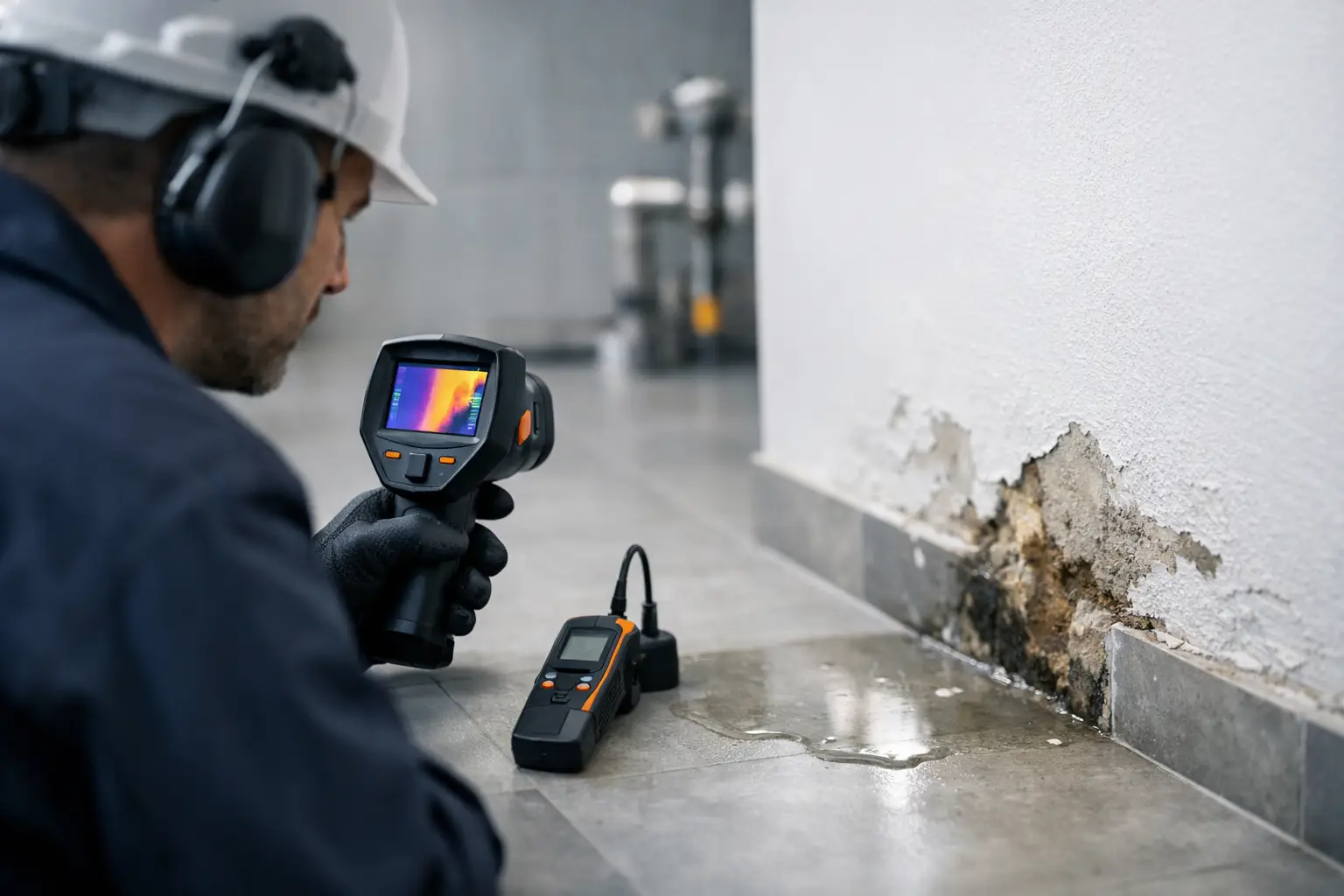
The survey typically combines visual inspection with instrument-based testing. Thermal imaging can identify temperature anomalies linked to moisture spread or active pipe runs. Acoustic equipment can detect the sound signature of pressurised water escaping from a pipe. Tracer gas can be introduced into a drained line where conventional acoustic methods are less reliable. Moisture meters, pressure testing, data logging, and technical inspection complete the picture.
That matters because the real cost is often not the leak itself. It is the wrong repair in the wrong place.
Why accuracy matters more than speed alone
Fast attendance is valuable, especially where active leakage is damaging finishes or affecting operations. But speed without a proper method often leads to guesswork. Many clients call for a non destructive leak survey after a plumber, maintenance team, or contractor has already opened the wrong area, replaced the wrong fitting, or patched a symptom rather than the cause.
An engineering-led survey does more than confirm that water is present. It identifies where the failure starts, how it travels, and whether the visible damage is actually remote from the source. Water can migrate along conduits, slab levels, wall cavities, insulation, and service routes. The stain on the ceiling below is often not directly under the failed point.
That is why a careful survey reduces total repair cost. If the diagnosis is right first time, the repair team can open only where necessary, order the right materials, and avoid repeated reinstatement work. In commercial settings, that also means fewer complaints, less downtime, and cleaner coordination across maintenance, insurance, and fit-out teams.
The technology behind a non destructive leak survey
Different leak conditions require different tools. There is no single device that finds every leak in every environment, and any provider who suggests otherwise is oversimplifying the job.
Acoustic leak detection
Acoustic testing remains one of the most effective methods for pressurised water pipe leaks. As water escapes, it creates vibration and noise that can be tracked using specialist sensors and listening equipment. The method is especially useful on domestic supply lines, irrigation networks, external mains, and many commercial systems.
Its limitation is that background noise, pipe depth, low pressure, and certain materials can reduce clarity. In busy plant rooms or live facilities, experience matters as much as equipment.
Thermal imaging
Thermal cameras do not “see” water directly. They detect temperature differences at the surface. That makes them valuable where leaking water changes the thermal profile of a floor, wall, or ceiling, or where pipe routing needs to be understood before intrusive work begins.
Thermal imaging is particularly useful for underfloor heating, concealed services, waterproofing assessment, and moisture pattern interpretation. It is less useful when temperature differential is minimal or when environmental conditions mask the reading.
Tracer gas testing
Tracer gas is highly effective when a line can be isolated and tested under controlled conditions. Gas escapes through the failure point and rises to the surface, where sensitive instruments detect it. This is often the preferred method for difficult concealed leaks where acoustic response is weak.
It can be slower than basic listening tests because preparation matters, but in complex cases it provides the certainty needed to avoid unnecessary breakouts.
Pressure testing and sectional isolation
Pressure testing helps determine whether a system is losing integrity at all, and sectional isolation narrows the failure to a specific branch or zone. These methods are essential in larger properties and commercial assets where multiple lines serve different areas.
Without this step, contractors can spend hours inspecting the wrong circuit.
Where these surveys deliver the most value
In homes and flats, the obvious value is preventing damage to finishes. Imported tiles, fitted kitchens, custom joinery, and decorative wall systems are expensive to disturb and even more expensive to reinstate well. A non destructive leak survey protects those finishes while getting to the real issue.
In villas and residential communities, underground leaks often present first as unusual bills, soft landscaping, pressure drop, or unexplained pump cycling. Locating the failure accurately avoids unnecessary excavation and shortens repair time.
For hospitality sites, schools, healthcare facilities, and retail environments, the priority is usually continuity. A leak in a guest room stack, chilled water circuit, washroom riser, or roof build-up can affect revenue, safety, and user experience. The survey needs to be accurate, discreet, and documented clearly enough for maintenance teams and insurers to act on.
Industrial and petrochemical environments raise the stakes again. Here, leak detection is not just about water damage. It can involve process integrity, corrosion risk, production impact, and safety controls. Survey work in these settings must align with site procedures, access limitations, and the technical demands of pipe networks, tanks, and critical utility systems.
What clients should expect from the survey outcome
A professional survey should leave you with more than a verbal opinion. You should expect a clear diagnosis, an explanation of the method used, the most likely leak point or failure zone, and practical repair guidance. Where conditions limit certainty, that should be stated directly rather than hidden behind vague language.
This is especially important when several stakeholders are involved. Homeowners may need evidence for a landlord or insurer. Facilities teams may need documentation for approval chains. Developers and contractors may need technical reporting for defect liability or quality assurance processes.
Good reporting also prevents drift. Once the source is identified, the repair scope becomes tighter, costs become easier to approve, and the risk of dispute drops.
When non-destructive does not mean zero disruption
A non destructive leak survey aims to minimise damage, not pretend that every leak can be solved without any opening up. That distinction matters.
Sometimes the survey identifies a leak point to within a very small tolerance, but final access is still required to expose and repair the pipe, joint, membrane, valve, or fitting. In those cases, the benefit is that only one targeted area needs to be opened, rather than several speculative ones.
There are also situations where the building fabric, pipe layout, or system condition limits what can be confirmed non-invasively. Dense reinforcement, high ambient noise, inaccessible voids, and mixed defect conditions can all complicate results. A credible specialist will explain those limitations early and adapt the method rather than force a poor reading.
That practical honesty is often what separates dependable diagnostics from expensive trial and error.
Choosing the right survey partner
The quality of a non destructive leak survey depends less on owning equipment and more on knowing when and how to use it. The right provider understands building pathology, pipe behaviour, moisture migration, and the commercial cost of delay. They can work just as comfortably in a family home as in a plant room, hotel, school, or industrial facility.
LeakDtech approaches surveys this way – as a technical investigation with a financial outcome. The objective is not simply to find water. It is to pinpoint failure accurately, reduce unnecessary breakage, and give clients a clean path to repair.
If you are facing recurring water loss, unexplained damp, rising utility costs, or a leak that others have failed to locate, the smartest first step is not to start breaking finishes. It is to get the diagnosis right while the problem is still small enough to control.