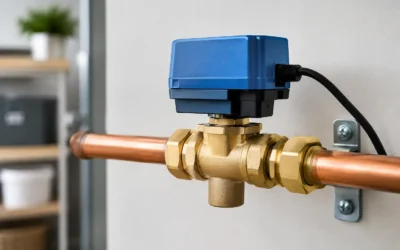
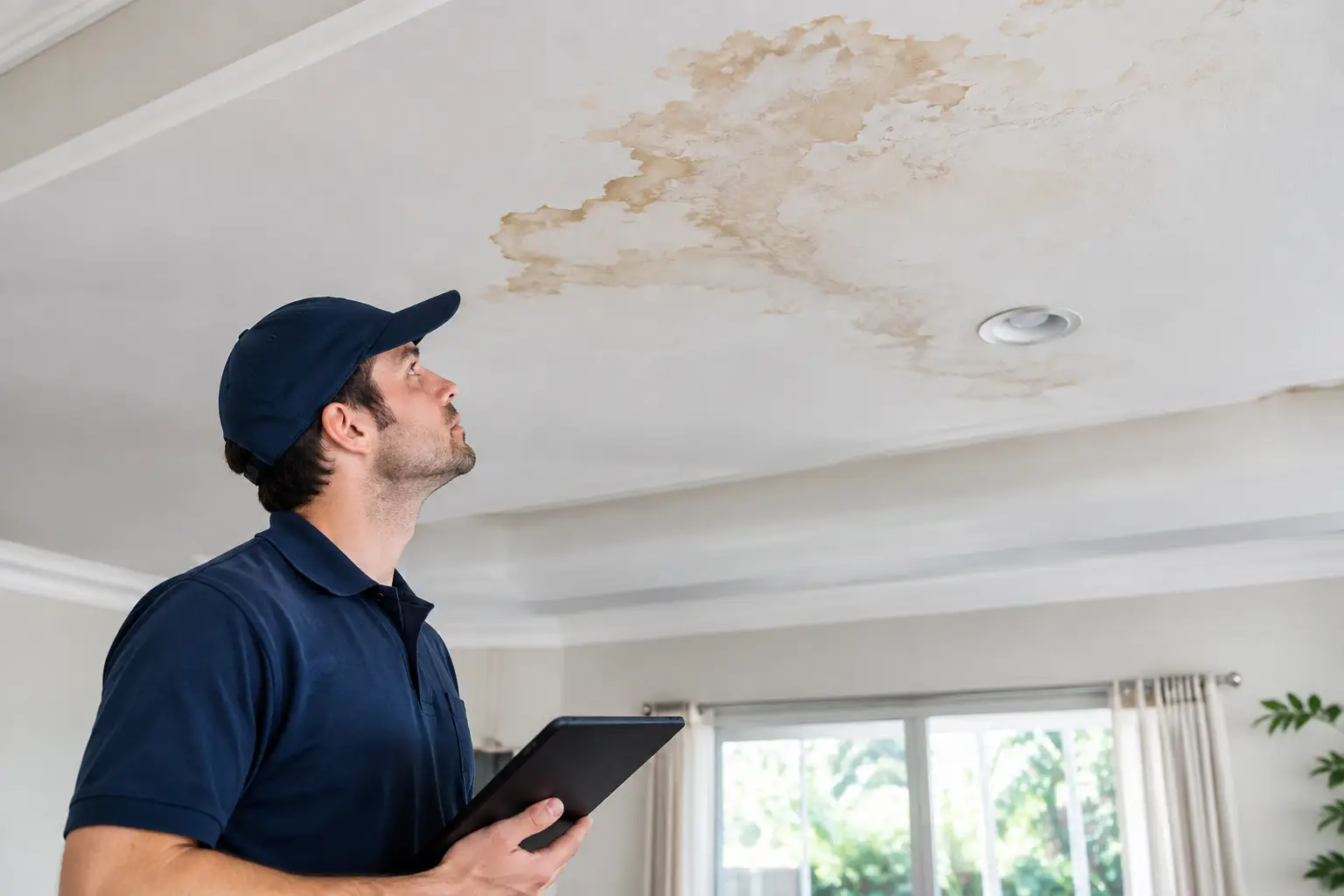
A brown ring on a villa ceiling is rarely just a paint problem. In this villa ceiling stain case study, the visible mark was the final symptom of a concealed plumbing failure above it – not the point where the water had entered. The difference mattered. Treating the stain alone would have left moisture in the structure, allowed mould conditions to develop and made a repeat repair highly likely.
The initial problem: a stain below an upstairs bathroom
The property owner reported a yellow-brown ceiling stain in the ground-floor living area, directly below an upstairs en-suite bathroom. The stain had appeared after several weeks of intermittent use of the bathroom and was gradually expanding at its edges. There was no active dripping, no obvious wet floor upstairs and no visible failure around the shower tray or basin.
This is a common and expensive scenario in villas. Water does not always travel vertically from the fault to the ceiling below. It can follow a pipe, slab joint, conduit or ceiling void before collecting at the weakest point in the gypsum board. The location of a stain is useful evidence, but it is not proof of the leak source.
The owner’s priority was clear: find the cause without removing large sections of the bathroom floor, wall tiles or living-room ceiling. A broad demolition approach might eventually have exposed the problem, but it would also have created unnecessary refurbishment costs and disruption.
Why a ceiling stain needs a technical investigation
A ceiling stain can result from several different failures. In a villa, the likely causes include a pressurised hot or cold-water pipe leak, a waste-water connection failure, compromised shower waterproofing, failed silicone or grout, air-conditioning condensate discharge, roof or terrace water ingress, or an overflow from a concealed tank or drainage line.
Each failure behaves differently. A pressurised pipe leak may continue even when no one is using the bathroom. A drainage leak may only appear when the shower, basin or toilet is discharged. Waterproofing defects are often linked to shower use and may cause moisture to spread slowly through the slab. If the stain worsens after rainfall or terrace washdown, external ingress becomes a stronger possibility.
Assuming the cause based on the room above is how repair budgets escalate. Replacing tiles or resealing a shower without testing can conceal the symptom temporarily while the actual leak remains active.
The diagnostic approach used in this villa ceiling stain case study
The inspection began with a visual survey of the affected ceiling, the bathroom above and adjoining walls. The survey documented the stain boundary, paint blistering, any ceiling sagging and nearby service points. Moisture readings were then taken across the ceiling surface to map the extent of elevated moisture rather than relying only on the discoloured area.
The moisture pattern extended beyond the visible ring towards the bathroom’s pipework wall. That did not identify the leak by itself, but it narrowed the investigation and helped establish where water was likely travelling.
Separating plumbing failure from waterproofing failure
The water supply to the bathroom was isolated and pressure-tested. A measurable pressure drop occurred over the test period, indicating a likely fault on the pressurised water network. This was significant because it ruled out a purely cosmetic ceiling issue and made a drain-only or waterproofing-only failure less likely.
Further checks were still necessary. More than one fault can exist in a property, especially where previous maintenance has been undertaken without a full diagnosis. The shower area was assessed for signs of failed seals, loose fittings and moisture migration around the tray. Drainage fixtures were also operated in a controlled sequence to identify whether discharge created an immediate moisture response.
No evidence suggested that the waste line or shower waterproofing was the primary driver of the ceiling damage. The pressure loss remained the strongest lead.
Locating the concealed leak accurately
Thermal imaging was used to identify temperature anomalies associated with concealed pipe routes and moisture migration. Thermal imaging does not see through concrete or directly display every leak. It detects surface temperature differences, which must be interpreted alongside pressure testing, moisture data and the building layout.
In this case, the thermal pattern was consistent with a cold-water line running near the wall-floor junction of the en-suite. Acoustic leak detection was then used to listen for the characteristic sound generated by water escaping from a pressurised pipe. The acoustic response was strongest in one restricted area, rather than across the entire bathroom.
The combined results pointed to a small pinhole failure on a concealed cold-water pipe close to the bathroom wall. The leak was not directly above the centre of the ceiling stain. Water had travelled through the slab and collected in the ceiling board below, where it became visible.
That distinction prevented an unnecessarily large opening in the living-room ceiling and avoided removing the full bathroom floor.
The repair strategy: access the fault, not the whole room
Once the likely location had been marked, a targeted access opening was made at the pipe route. The plumber confirmed a localised pipe defect and completed the repair. The line was then pressure-tested again to confirm that the system was holding stable.
Only after the plumbing repair was verified did the restoration work begin. The damp section of the ceiling was assessed for structural integrity. Where gypsum board has softened, sagged or developed mould contamination, replacement is usually safer than patching. In this case, the damaged area was removed in a controlled section, the void was dried, and the ceiling was reinstated after moisture readings showed acceptable improvement.
Repainting a ceiling before drying is complete is a false economy. Stain-blocking paint may improve appearance, but it cannot correct ongoing moisture or prevent trapped damp from causing further deterioration.
What reduced the cost in this case
The main saving came from diagnosis before demolition. The property owner did not have to approve broad tile removal, replace an entire bathroom floor or open long runs of ceiling in search of a fault. The repair scope was based on evidence from the inspection, pressure test, thermal assessment and acoustic confirmation.
There was also a secondary saving: early action limited the area of ceiling replacement. Left unresolved, a minor pressurised leak can saturate insulation, corrode metal components, weaken gypsum board and create conditions favourable to mould. What starts as a small stain can become a wider refurbishment project involving decoration, joinery and temporary loss of room use.
For landlords and property managers, documented test findings also provide a clearer maintenance record. This is valuable when allocating responsibility between a tenant, maintenance contractor, builder or insurer, particularly where water damage has developed gradually.
Lessons for villa owners and facilities teams
A ceiling stain should be treated as an active building diagnostic issue until testing proves otherwise. Do not assume it is caused by the nearest shower, and do not wait for dripping water before arranging an inspection. By the time a stain becomes visible, water may already have been migrating through concealed materials for some time.
There are practical observations that can help an engineer assess the problem. Note whether the stain changes after shower use, toilet flushing, air-conditioning operation, irrigation activity, heavy rain or periods when the villa is vacant. Record any unexplained increase in water consumption. These patterns can help distinguish between supply-line, drainage, cooling and external-ingress faults.
It also depends on the construction. A stain below a top-floor ceiling may justify immediate roof, terrace and condensate-line checks. A stain beneath a wet room requires plumbing and waterproofing assessment. In a multi-storey villa, service routes and slab penetrations may mean the leak is some distance from the visible damage.
A cleaner route from stain to repair
The purpose of non-invasive leak detection is not to avoid access work at all costs. A confirmed repair still needs access to the failed component. The objective is to make that access small, justified and accurately located.
LeakDtech applies this evidence-led approach to concealed water failures in Dubai villas, combining inspection methods according to the property and the suspected failure type. For an owner facing a new ceiling stain, the most useful next step is not another coat of paint. It is a diagnosis that identifies where the water is coming from, confirms the repair and protects the property before a minor defect becomes major damage.