A tank that loses water, pressure or product is not automatically a tank that needs replacing. In many cases, the right diagnosis can isolate a failed joint, lining defect, connection or valve issue before a major capital decision is made. Tank testing versus replacement is therefore not a simple maintenance choice – it is a decision about safety, operational continuity, compliance and the true cost of failure.
For a villa owner, the issue may be an underground water tank driving up DEWA bills or causing persistent dampness. For a facilities manager, it may be a fire water tank with uncertain integrity. For an industrial operator, it could involve process water, chemicals or hydrocarbons where an unplanned outage carries serious financial and environmental consequences. The evidence required is different in each case, but the principle remains the same: test first, then decide from verified condition data.
Why replacement is often considered too early
Replacement feels decisive. It can also be expensive, disruptive and unnecessary when the tank shell remains structurally sound. Removing and renewing a tank may involve isolation, drainage, access works, demolition, lifting equipment, pipe alterations, recommissioning and lost operating time. In occupied properties, it can also mean disruption to water supply and damage to finishes around the tank location.
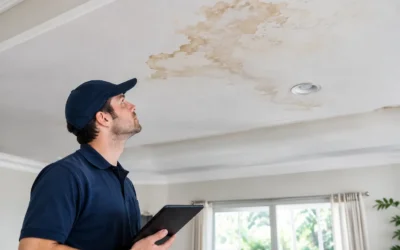
A visible leak does not always identify the source. Water can travel along concrete, pipe sleeves, joints and service penetrations before appearing at a ceiling, wall or floor. A tank blamed for a loss may be sound, while the actual fault lies in connected pipework, overflow lines, pumps, float valves or buried supply routes.
The opposite risk is equally costly. Repeated patch repairs on a deteriorating tank can consume maintenance budgets while allowing corrosion, contamination or structural weakness to worsen. The objective is not to preserve every asset indefinitely. It is to establish whether repair is technically reliable, whether replacement is justified, and what action reduces total risk.
Tank testing versus replacement: the evidence-led approach
A professional assessment starts by separating three questions: is the tank leaking, where is the failure occurring, and is the tank fit to remain in service? These questions sound similar, but they require different forms of testing.
Water tightness testing can confirm whether a tank is losing volume under controlled conditions. Pressure testing may be appropriate for associated pipework and closed systems. Visual inspection can identify cracking, failed sealant, corrosion, coating breakdown, settlement and deterioration around penetrations. Where access or construction makes the source unclear, non-invasive methods such as acoustic testing, thermal imaging, tracer gas and moisture investigation can narrow the search without unnecessary excavation or demolition.
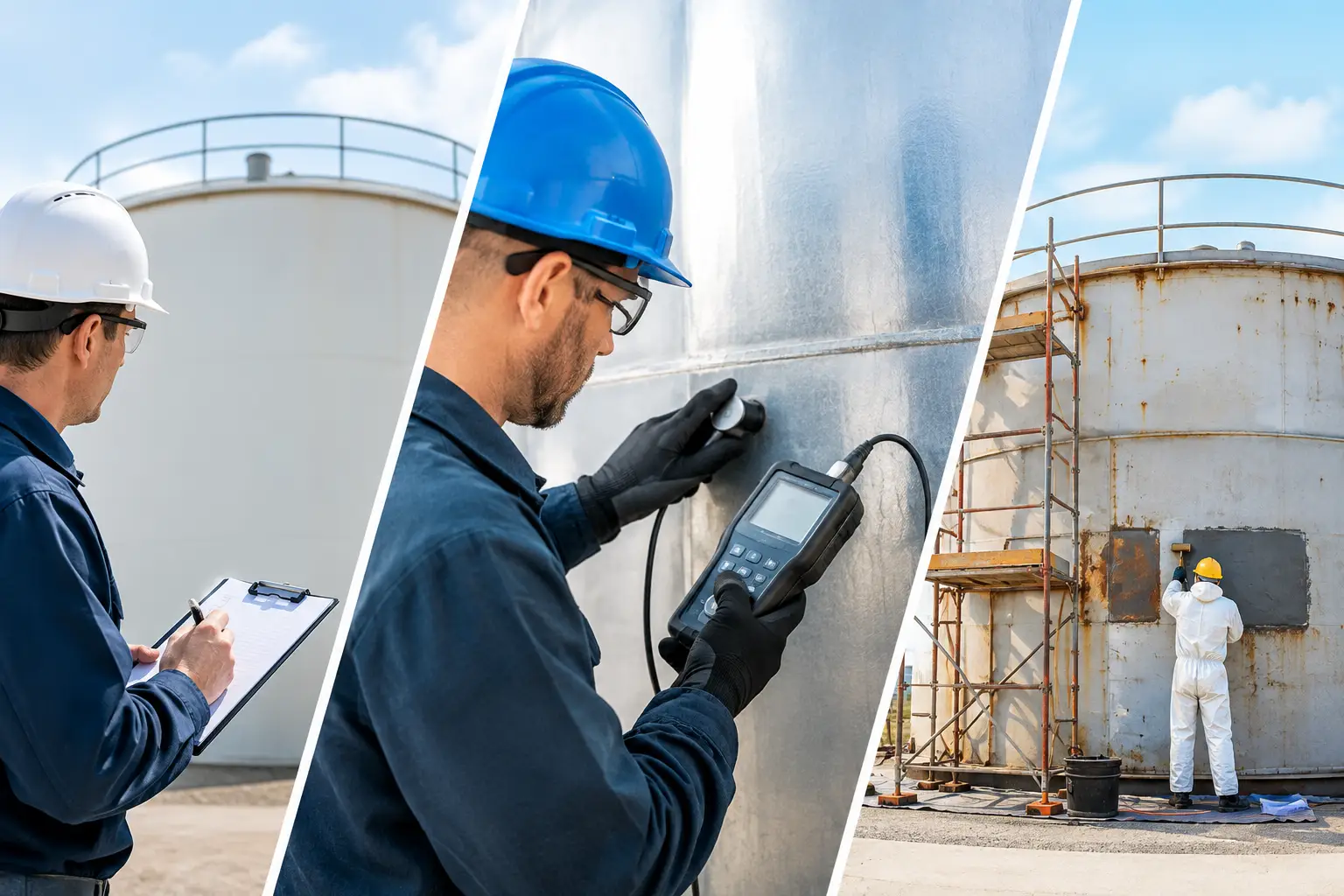
For industrial and petrochemical applications, the scope may also include non-destructive testing of tank walls, welds, nozzles and connected lines. Thickness measurements, corrosion mapping and targeted inspection help determine whether metal loss is localised and manageable or widespread enough to affect structural integrity.
Testing should produce more than a verbal opinion. Decision-makers need documented findings, test conditions, identified defects, photographic evidence where relevant, risk observations and clear recommendations. This provides a defensible basis for approving a repair, planning replacement, supporting handover discussions or managing an insurance claim.
When testing and repair are the better investment
Testing is particularly valuable when the tank is relatively modern, has a limited leak history, or shows a fault that may be isolated to one component. A sound concrete, GRP or steel tank can often remain in service where the issue is confined to a failed waterproofing layer, cracked joint, leaking flange, defective outlet connection or damaged internal lining.
Repair may be commercially sensible when the tank can be isolated without major operational impact and the corrective work can be verified through retesting. For example, a leaking expansion joint or pipe penetration can often be repaired far more efficiently than replacing the full tank. In a building with concealed infrastructure, locating the exact source before opening finishes avoids paying for broad demolition based on assumptions.
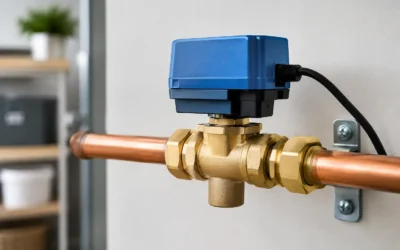
There are also situations where a reported tank leak is not a tank fault at all. An inaccurate water balance, a malfunctioning float valve, uncontrolled overflow, leaking irrigation connection or downstream pipe failure can mimic tank loss. Replacing the tank in these circumstances solves nothing and creates an avoidable capital cost.
A repair-first approach should not mean a cheap or temporary fix. The repair method must match the tank material, stored medium, operating temperature, pressure conditions and hygiene requirements. Potable water tanks, fire tanks and chemical containment systems have different performance demands. The repaired area should be tested under realistic conditions before the asset is returned to normal duty.
When replacement is the safer commercial decision
Replacement becomes the stronger option when testing identifies systemic deterioration rather than a local defect. This may include widespread corrosion, substantial wall thinning, recurring cracks, chronic leakage after previous repairs, settlement damage, failed structural supports or a lining that has reached the end of its serviceable life.
The age of a tank matters, but age alone is not a replacement criterion. Some older tanks remain serviceable because they have been maintained well and operate in favourable conditions. Others deteriorate quickly due to water chemistry, poor installation, inadequate coatings, aggressive environments, irregular cleaning or unsuitable repair materials.
Replacement should also be considered when a tank no longer meets the operational requirement. A capacity shortfall, poor access for cleaning, repeated contamination concerns, obsolete fittings or an inability to isolate the system safely can make renewal more economical than continued intervention. For high-consequence assets, the cost of a single failure may exceed the cost of planned replacement many times over.
In Dubai, this is especially relevant for tanks exposed to high ambient temperatures, demanding duty cycles and water quality conditions that can accelerate deterioration. Planned renewal during a controlled maintenance window is far preferable to emergency replacement after a leak damages property, interrupts service or compromises a critical system.
What a useful tank condition assessment should include
A credible assessment is proportionate to the asset and its risk. A domestic underground tank does not need the same programme as an industrial storage system, but both require more than a quick visual check. The inspection should establish the construction type, capacity, operating use, access limitations, previous repairs and the pattern of any water loss.
Testing then needs to be selected around the suspected failure mode. Level monitoring and controlled fill testing may be suitable for water tightness. Pressure testing can help distinguish a tank loss from a pipework loss. Acoustic or tracer gas methods can assist where leakage is hidden below ground or behind finishes. Thermal imaging can identify associated moisture pathways, although it does not replace a dedicated leak test.
The final recommendation should rank the available actions. It may advise immediate repair, monitored operation with a planned intervention, further investigation, partial refurbishment, or full replacement. It should also state the consequences of deferring work. This is where condition data becomes commercially useful: it allows owners and managers to prioritise spend rather than react to the most visible symptom.
Avoid the false economy of guesswork
A common mistake is to authorise replacement because several contractors have attempted repairs without success. Repeated failed repairs usually indicate that the actual leak path was never confirmed, not necessarily that the entire tank is beyond recovery. Conversely, a succession of minor repairs can conceal a worsening structural problem and delay the replacement that is genuinely required.
The right answer depends on defect location, material condition, criticality, repair history and the cost of downtime. It also depends on what failure would mean for the people and operations relying on that tank. A decorative water feature and a fire suppression reserve do not carry the same risk profile.
LeakDtech approaches tank problems with the same discipline used for hidden leaks across complex properties: identify the source accurately, test the condition objectively and recommend the action that protects the asset without creating unnecessary disruption. That may mean a targeted repair. It may mean replacement. The value lies in knowing which before budgets are committed.
Before draining, demolishing or ordering a new tank, commission testing that can answer the questions your maintenance team, insurer or operations manager will ask afterwards. A clear diagnosis keeps a manageable defect from becoming a major project – and prevents a major risk from being treated as a minor repair.