
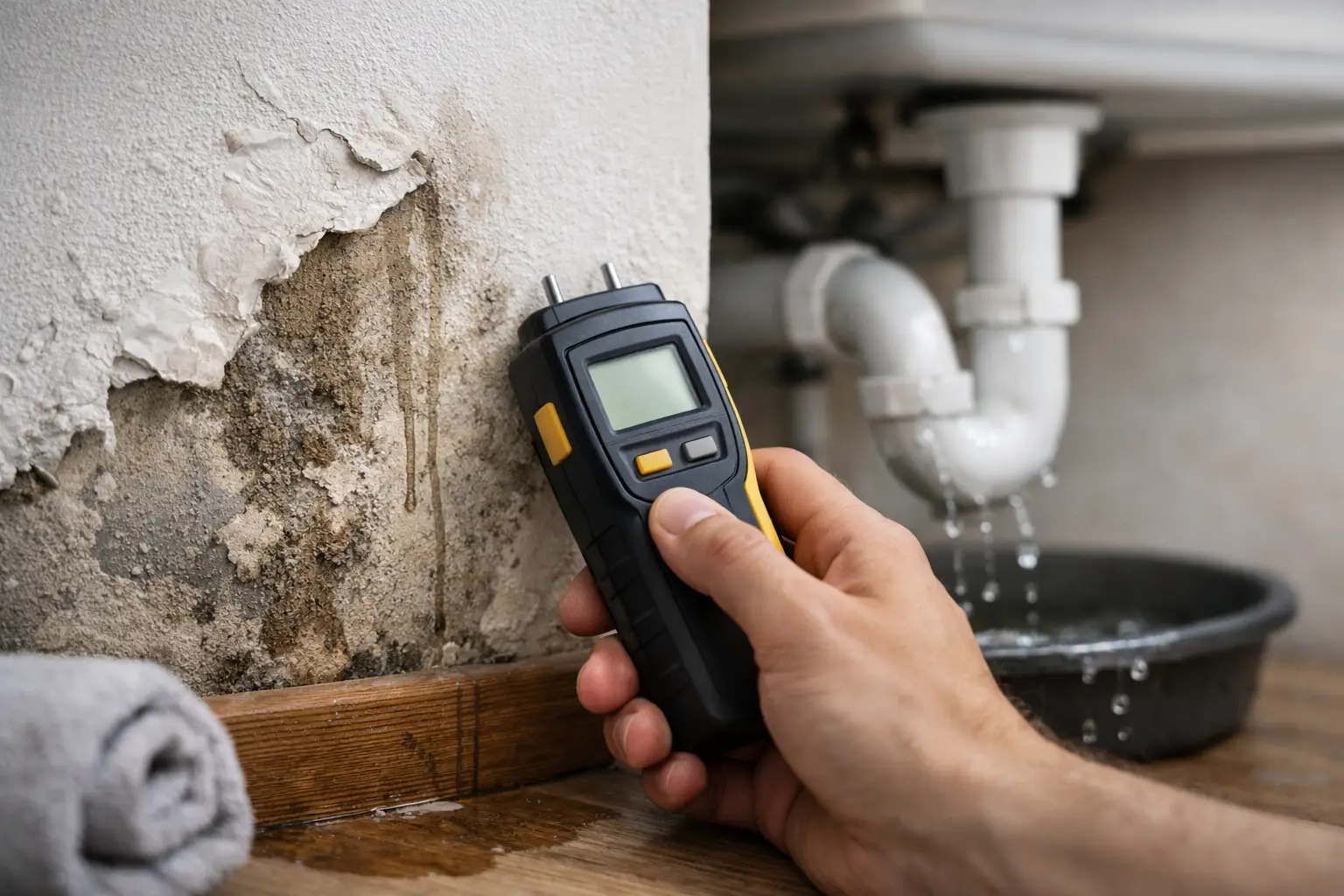

A hidden leak rarely announces itself with a burst pipe and a flooded floor. More often, it shows up as a water bill that makes no sense, a stubborn damp smell in one room, or paint that starts to blister for no obvious reason. Spotting the signs of hidden water leak issues early can save thousands in repairs, reduce wasted water, and prevent avoidable disruption in homes, commercial buildings, and technical facilities.
The challenge is that hidden leaks do not all behave the same way. A leak behind a bathroom wall, beneath tiled flooring, inside an irrigation line, or along a chilled water network will each leave different clues. Some are visible. Others only become clear when building materials start failing, mould appears, or system performance drops. The earlier those clues are investigated properly, the easier it is to isolate the cause without unnecessary demolition.
Why hidden leaks become expensive fast
Water travels. That is what makes concealed leaks so damaging and so easy to misread. The source may be in one area while the visible damage appears several metres away. By the time staining reaches a ceiling, skirting board, corridor wall, or plant room floor, moisture may already have affected insulation, joinery, finishes, or electrical areas.
For homeowners and tenants, that often means swelling cabinetry, ruined paintwork, mould growth, and persistent humidity. For facilities managers, developers, hospitality operators, and industrial sites, the cost is broader. Undetected leakage can drive up utility spend, interrupt operations, compromise asset integrity, and create disputes over maintenance responsibility or latent defects.
This is why leak detection should not start with breaking walls at random. It should start with reading the symptoms correctly and then confirming the source with non-invasive testing.
The most common signs of hidden water leak
A sudden rise in water consumption is usually the first hard indicator. If your usage pattern has not changed but the bill has climbed sharply, there is a reason. In domestic properties, this may point to a concealed supply line leak, leaking toilet feed, underground service leak, or irrigation fault. In larger properties, unexplained consumption can indicate losses across distribution lines, tanks, or poorly isolated systems.
Damp patches are another common warning sign, but they need careful interpretation. A dark area on a wall or ceiling does not always mean the leak is directly above or behind it. Water can track along beams, conduits, and slab paths before becoming visible. That matters because surface repairs alone often fail when the real source is somewhere else.
Peeling paint, bubbling plaster, and warped finishes are closely related signs. Paint films lose adhesion when moisture content rises behind them. Timber skirting, doors, and built-in joinery may swell or distort. In tiled spaces, grout may discolour and tiles can start sounding hollow if moisture affects the substrate.
A musty odour that lingers even after cleaning is another red flag. Hidden moisture creates the right conditions for mould growth inside cavities, behind cupboards, under flooring, and within service shafts. If a room smells damp but looks mostly normal, that does not mean the problem is minor. It may simply be concealed.
Reduced water pressure can also point to leakage, particularly when it appears gradually and no fixture issue explains it. Pressure loss does not always mean a visible pipe failure. Small leaks on concealed lines can reduce performance over time, especially in larger properties or systems with long pipe runs.
You may also hear the leak before you see it. A faint hissing, trickling, or rushing-water sound when no tap is running can indicate a concealed pipe defect. In quiet buildings, this can be one of the clearest early signs, especially at night when background noise drops.
Signs of hidden water leak in walls, floors, and ceilings
Leaks inside wall cavities often show up as localised staining, soft plaster, cracking paint, or mould around corners and socket areas. Bathrooms, kitchens, risers, and service walls are common locations, but any pressurised or waste line can fail if workmanship, material condition, or movement has compromised it.
Underfloor leaks are often harder to identify without equipment. You may notice unexpected warm or cold spots, lifting floor finishes, persistent dampness along grout lines, or a section of floor that never fully dries after cleaning. In villas and ground-floor units, slab leaks can also migrate into adjacent rooms before any obvious surface damage appears.
Ceiling leaks create another layer of confusion because the visible patch may come from pipework, drainage, roof waterproofing, AC condensate lines, or upper-floor wet areas. Brown staining, sagging gypsum board, and recurring paint failure are typical symptoms. If the problem returns after cosmetic repair, the leak source has not been properly traced.
When the problem is outside the building
Not every concealed leak is indoors. External water losses are common in gardens, irrigation systems, pool lines, service corridors, and underground supply routes. The signs are different but just as important.
You may see one area of landscaping that stays unusually green, soft, or muddy. Paving may settle unevenly. Boundary walls can show unexplained dampness. In commercial and community settings, underground leaks often reveal themselves through repeated topping up of tanks, abnormal pump cycling, or unexplained pressure drops.
For larger sites, this can become a serious operational issue. A concealed leak on a fire line, chilled water pipe, transfer line, or process pipework does not just waste water. It can affect compliance, efficiency, and business continuity. The right response depends on the system, which is why technical inspection matters.
What people often get wrong
One common mistake is assuming visible damage marks the exact leak location. It often does not. Another is treating symptoms instead of causes – repainting over damp areas, replacing swollen panels, or repeatedly resealing a bathroom without testing whether the water is coming from plumbing, waterproofing, drainage, or condensation.
There is also a tendency to wait. If the leak seems small, some owners hope it will stabilise. In reality, small hidden leaks can continue for months, quietly affecting concrete, screed, blockwork, finishes, and indoor air quality. By the time major damage is obvious, repair scope is usually much wider.
For commercial operators and FM teams, the biggest risk is delayed diagnosis after an initial failed repair. Once multiple contractors have made assumptions, cost rises quickly and accountability becomes blurred. Accurate location data early in the process saves money.
How hidden leaks are confirmed properly
The right method depends on the building type, the suspected system, and the symptoms present. A domestic bathroom leak may require moisture mapping, thermal imaging, and pressure testing. An underground line may call for acoustic tracing or tracer gas. An industrial or petrochemical environment may need more specialised non-destructive testing and documented inspection protocols.
What matters is precision. Non-invasive leak detection is not just about avoiding mess, although that is a major advantage. It is about reducing guesswork. Instead of opening three walls to find one pipe defect, targeted diagnostics narrow the search area and identify whether the issue is live water, drainage, waterproofing failure, tank leakage, or another source entirely.
This is where an engineering-led approach makes a difference. The symptom on the surface is only part of the story. The real task is understanding the system behind it, how water is behaving, and which test method will produce reliable evidence.
When to act on the signs of hidden water leak
If you have one mild symptom, such as a faint damp smell or isolated blistering paint, it may still be worth checking before damage spreads. If you have two or more signs together – for example a rising bill, mould growth, and reduced pressure – delay is costly.
Urgency increases where there are vulnerable finishes, occupied guest rooms, electrical installations, data rooms, healthcare areas, or production assets nearby. In those environments, even a modest leak can become a much larger risk if moisture migration continues unchecked.
LeakDtech works with both residential and complex commercial environments for exactly this reason: the leak itself is only one part of the cost. The bigger issue is what happens around it if diagnosis is slow or inaccurate.
The best time to investigate a suspected hidden leak is before someone starts hacking at walls, shutting down systems, or replacing finishes that will only fail again. Early evidence gives you options. Leave it too long, and the building makes the decision for you.
If something in your property feels off – the smell, the bill, the pressure, the patch that keeps coming back – trust the pattern. Water rarely disappears on its own. It only gets harder and more expensive to trace once the damage spreads.