
A leak rarely announces itself where it starts. The stain on a ceiling, the damp wall in a corridor, the drop in system pressure or the spike in a water bill is usually just the consequence. That is why the best methods for leak tracing are not about guesswork or opening up large areas in the hope of getting lucky. They are about finding the leak path, confirming the failure point and protecting the property or operation from unnecessary disruption.
For homeowners, that can mean avoiding needless tile removal and refurbishment costs. For facilities teams, it can mean preventing tenant complaints, mould growth and repeat contractor visits. For industrial and petrochemical sites, it can mean maintaining output, reducing shutdown exposure and preserving safety. The right tracing method depends on the pipe material, system type, environment and severity of the leak. There is no single tool that solves every case.
Why the best methods for leak tracing depend on the system
The first mistake in leak detection is treating every leak as the same problem. A domestic pressurised water pipe beneath screed behaves very differently from a buried irrigation line, a roof waterproofing failure, a chilled water network or a process pipe in an industrial plant. Each demands a different approach.
A good tracing strategy starts with diagnosis, not demolition. Pressure behaviour, pipe routing, material type, historical repairs, occupancy patterns and the visible symptoms all matter. If a leak appears only when a pump is running, that tells one story. If moisture remains constant during isolation, that suggests another. The best technical teams work backwards from the evidence and choose methods that narrow the search quickly.
This matters financially. Random excavation and blind wall opening often cost more than the detection work itself, especially when finishes need reinstating. It also matters operationally. In hotels, hospitals, schools, retail sites and industrial facilities, opening up the wrong area can create disruption that far exceeds the cost of the leak.
Acoustic leak detection
Acoustic testing remains one of the most effective methods for pressurised pipe leaks. When water escapes from a pipe under pressure, it creates vibration and sound. Sensitive listening equipment allows technicians to track that sound through floors, walls, soil or pipework and identify the likely point of failure.
Used properly, acoustic detection is fast and highly targeted. It performs well on metallic pipework and many pressurised water systems where background noise can be controlled. In villas, flats, plant rooms and commercial buildings, it is often one of the first methods used because it can confirm whether a leak is active and help define the search area.
The trade-off is that acoustics are not equally reliable in every setting. Plastic pipes can carry leak sound differently, deep burial can weaken signal clarity, and busy environments with mechanical noise can interfere with readings. A technician who understands the building and the system will know when acoustic results are strong enough to act on and when they need supporting evidence.
Thermal imaging for hidden moisture patterns
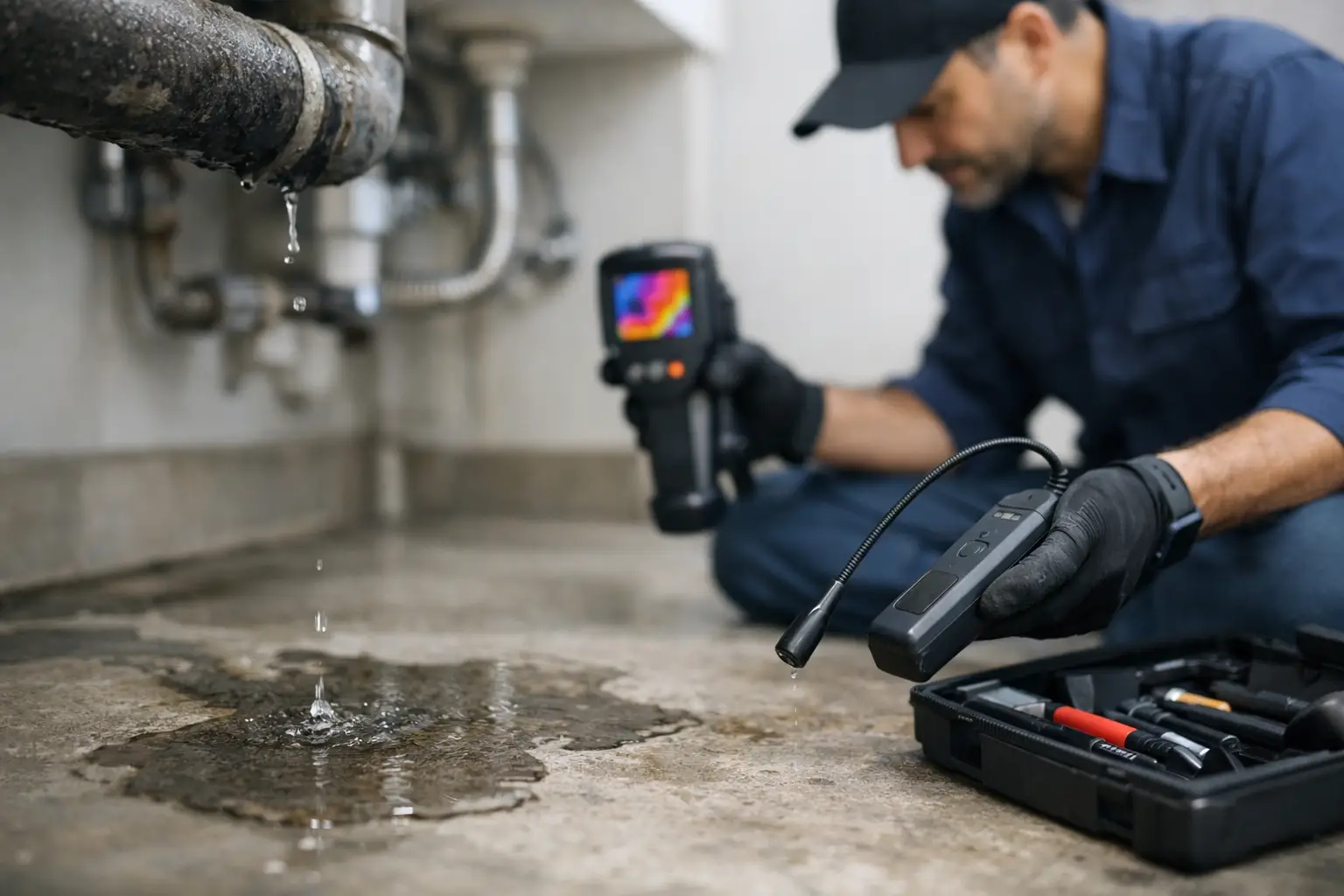
Thermal imaging does not usually see the leak itself. It sees temperature differences caused by moisture movement, evaporative cooling or temperature variation in active pipework. That distinction matters. In the right hands, thermal imaging is extremely useful for mapping affected areas and tracing moisture spread behind finishes, within ceilings and across waterproofing systems.
It is particularly effective where hot water pipes are involved or where moisture has created a distinct thermal pattern. In residential properties, this can help reduce damage by identifying likely leak routes before any access works begin. In larger buildings, it can assist in screening broad areas quickly, especially when there is uncertainty about how far water has travelled.
Thermal imaging is best used as part of a wider diagnostic process. Surface temperature can be influenced by air conditioning, solar gain, occupancy and construction materials. A thermal camera does not replace pressure testing or physical verification. It adds speed and visual evidence, which is valuable when a client needs a clear explanation before approving remedial works.
Tracer gas testing for difficult and concealed leaks
When a leak is small, intermittent or buried in a way that defeats conventional methods, tracer gas testing is often the strongest option. The principle is straightforward. The pipe or system is isolated, drained where necessary, then filled with a safe test gas mixture. Because the gas molecules are extremely small, they escape through the leak point and rise to the surface, where sensitive detectors can pick them up.
This is one of the best methods for leak tracing in concealed pipe networks, under tiled areas, beneath screed, within buried external lines and across systems where water leakage is too subtle to localise with sound alone. It is especially useful after failed repair attempts, where clients know there is still a leak but cannot justify more exploratory damage.
Tracer gas is also valuable in commercial and industrial contexts because it can provide high confidence with minimal intrusion. The limitation is that it requires proper system preparation and experienced interpretation. Gas migration can be affected by soil conditions, voids, insulation and structural pathways. Good technique matters as much as the equipment.
Pressure testing and sectional isolation
Pressure testing is less glamorous than a thermal camera or gas detector, but it remains fundamental. Before tracing a leak precisely, you need to confirm whether the system is actually losing pressure, how quickly that loss occurs and whether the problem can be narrowed to a specific section.
Sectional isolation is often what separates efficient leak tracing from expensive confusion. By isolating branches, zones or risers and testing them independently, technicians can reduce a large system to a manageable search area. In domestic properties, this may identify whether the issue lies in hot water, cold water or external feed lines. In commercial buildings, it can distinguish tenant-side problems from landlord infrastructure. In industrial systems, it can prevent unnecessary shutdown of healthy sections.
Pressure testing on its own will not pinpoint the exact leak location, but it provides the framework for every method that follows. It tells you where to focus. It also provides documented evidence that is useful for insurers, facilities managers, developers and maintenance teams who need technical certainty before authorising repairs.
Moisture mapping and technical inspection
Some leaks are not pipe failures at all. They are waterproofing defects, façade penetrations, drainage issues, tank cracks, failed sealants or condensation misdiagnosed as leakage. That is why technical inspection and moisture mapping are essential.
A competent survey looks at building pathology as well as plumbing. Staining patterns, material deterioration, moisture gradients, construction joints, roof falls and service penetrations all help explain what is happening. In many cases, the visible symptom is blamed on the nearest pipe when the true cause is ingress from above or laterally through the structure.
For property managers and developers, this is where real savings happen. Replacing pipework that was never leaking does not solve the problem. Identifying the failure mechanism correctly does. That is why engineering-led inspection is often the difference between a one-off repair and a recurring defect cycle.
Choosing the best methods for leak tracing in each environment
In a house or flat, speed and cleanliness usually come first. The goal is to find the issue with as little disruption as possible, particularly where finished surfaces are involved. Acoustic testing, thermal imaging and targeted pressure checks are often the most efficient combination, with tracer gas reserved for harder cases.
In facilities management, the priority is usually continuity. A school, hospital, shopping centre or residential community cannot afford repeated false starts. Sectional isolation, detailed reporting and non-invasive confirmation methods become more important because multiple stakeholders are involved and access may be limited.
In industrial and petrochemical environments, the stakes are higher again. Leak tracing must support safety, compliance and uptime. That means using methods that fit operating conditions, material specifications and permit requirements. Not every test can be applied while a system is live, and not every leak should be approached as a maintenance issue when it may have wider integrity implications.
Across all sectors, the best result comes from combining methods rather than relying on one device. A pressure test may confirm a leak, acoustics may narrow it, thermal imaging may map impact and tracer gas may provide final location. The method matters, but the sequence matters too.
When clients call LeakDtech, they are usually not looking for another opinion. They are looking for certainty, a clean diagnosis and a repair path that avoids wasted time and unnecessary opening up.
If you are dealing with a leak that keeps returning, a bill that does not make sense or a system losing pressure without an obvious cause, the right next step is not more damage. It is better evidence, gathered with the method that fits the problem.