
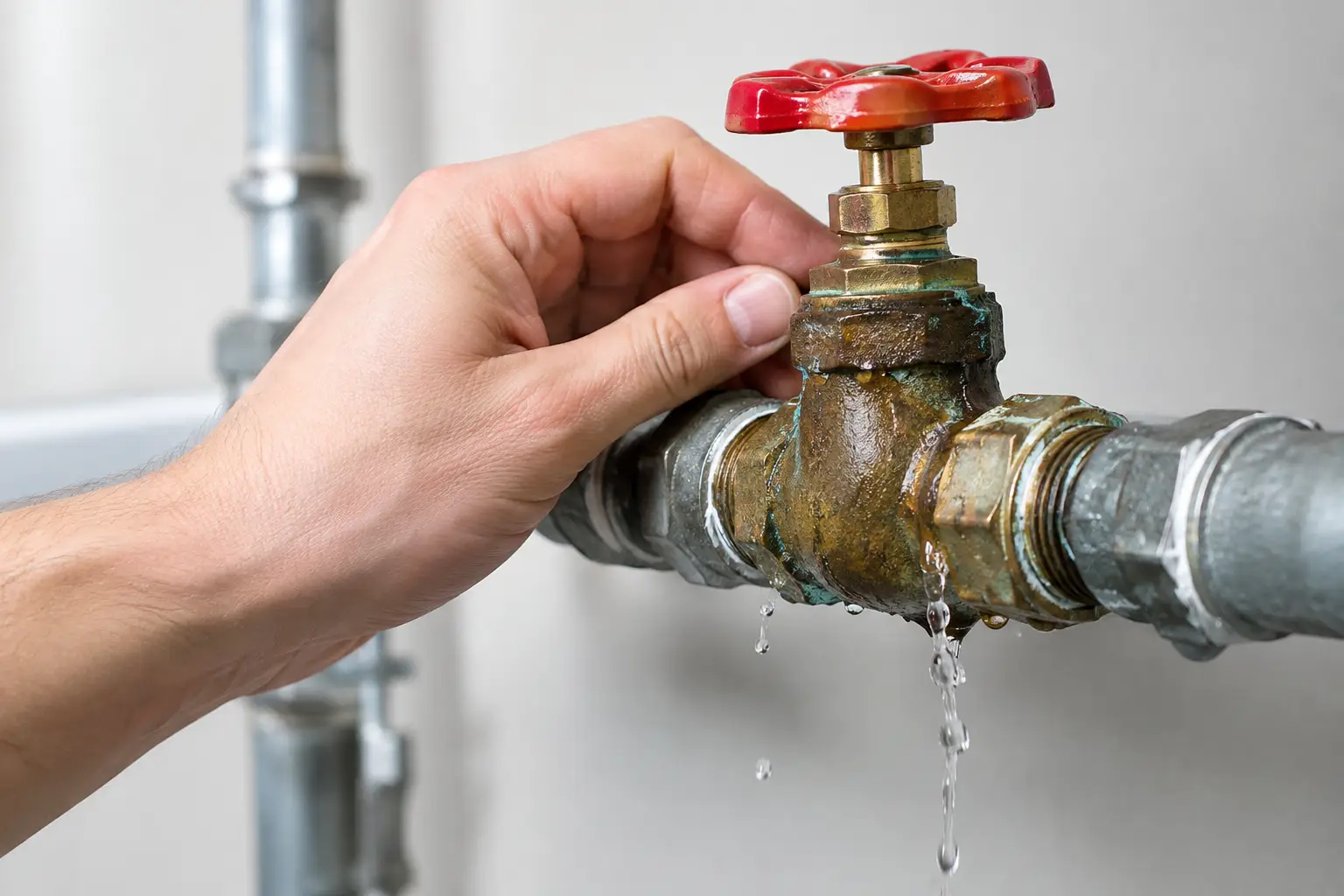

A valve rarely fails without leaving evidence. A rising water bill, a pressure drop after isolation, a pump that keeps cycling, or water appearing where it should not be can all point to the same issue. If you are asking what indicates a failing valve, the answer depends on the valve’s purpose, but the warning signs are usually visible in system behaviour long before the valve stops working completely.
For villa owners, this may mean a concealed isolation valve allowing water to pass when it should be shut. For facilities managers, it may mean a pressure-reducing valve causing unstable supply across a building. In industrial, fire protection or chilled-water networks, a faulty valve can create operational risk, unplanned downtime and expensive investigation work. Accurate diagnosis matters because replacing the wrong component does not solve the underlying fault.
What Indicates a Failing Valve?
A failing valve is one that no longer opens, closes, regulates or seals as designed. The most common indication is loss of control: water continues to flow through a closed valve, pressure does not hold after isolation, or the system delivers too much or too little flow.
Not every fault is dramatic. A valve may be partially obstructed by scale, sediment or corrosion, so it works intermittently but cannot meet demand at peak use. A worn seal may only leak under higher pressure. An electrically actuated valve may appear mechanically sound while its actuator, wiring or control signal has failed.
The useful question is not simply whether a valve is old. It is whether measured flow, pressure and isolation performance match what the system should be doing.
Warning Signs You Should Not Ignore
Water continues after the valve is closed
A correctly functioning isolation valve should stop flow to the relevant section of pipework. If a tap, irrigation zone, toilet supply or downstream line continues running after isolation, the valve may be passing internally.
A small amount of residual water can drain from pipework immediately after closure. Continued flow, however, is different. It may indicate a damaged washer, degraded seat, debris caught inside the valve or a cracked internal component. In concealed plumbing, this can make a routine repair far more disruptive because the section cannot be isolated with confidence.
Pressure will not hold during testing
Pressure testing is one of the clearest ways to assess valve integrity. Once a section has been isolated and pressurised, the gauge should remain stable within the expected test conditions. A falling pressure reading can indicate a leak in the pipework, a faulty fitting or a valve that is allowing pressure to bypass it.
This is why a pressure loss alone should not be treated as proof of a pipe leak. The test boundary must be verified first. If an isolation valve does not seal fully, it can produce misleading results and send maintenance teams towards unnecessary excavation or demolition.
Unstable water pressure or poor flow
Low flow at a shower, tap or process point is not always a supply issue. A gate valve that has not been fully opened, a blocked strainer, a seized valve stem or a failing pressure-reducing valve can restrict water movement. Conversely, excessive downstream pressure may indicate that a regulating valve is no longer controlling pressure correctly.
Look for patterns. If pressure is poor at one outlet only, the issue may be local. If several areas are affected, especially after a pump starts or demand increases, a shared valve, booster set or control arrangement is more likely to be involved.
Noise, vibration or water hammer
Banging pipes, chattering, whistling or vibration around a valve deserve investigation. These symptoms can occur when a valve is partially closed, incorrectly sized, loose internally or subjected to unsuitable pressure conditions. They can also arise when flow direction is wrong through a check valve, or when a non-return valve is sticking.
Noise does not confirm the fault on its own, but it is valuable diagnostic evidence. Acoustic testing can help locate abnormal turbulence and identify whether the sound is originating at the valve, a nearby restriction or a concealed leak.
Visible corrosion, mineral deposits or dampness
External signs are often overlooked because a valve may still operate when turned by hand. Green staining on copper, white mineral deposits, rust, flaking coatings or damp insulation can show that a valve body, bonnet, spindle or joint is leaking slowly.
In Dubai, heat, high water demand and hard-water scaling can accelerate wear in certain systems. Plant rooms, irrigation installations, rooftop tanks and outdoor service areas need particular attention because small drips can remain undetected until corrosion, mould or water damage has already developed.
Repeated pump cycling or unexplained consumption
A pump that starts and stops more often than usual may be responding to pressure loss downstream. A leaking valve, failed non-return valve or bypassing solenoid can all contribute. The same applies to an unexplained increase in water consumption, particularly where meter readings rise despite unchanged occupancy or irrigation schedules.
Smart monitoring can reveal these patterns quickly. Continuous flow during periods when a property should be inactive is a strong reason to test the network, including valves, rather than assuming the meter is at fault.
Different Valves Fail in Different Ways
The type of valve matters. Isolation valves are expected to seal fully. Their main failure mode is internal passing, external leakage or seizure. Ball valves are generally reliable, but their seats can wear and their handles can give a false impression of full closure if the internal ball is damaged or obstructed.
Check valves, also called non-return valves, prevent reverse flow. When they fail, pressure may bleed back towards a tank or pump, hot and cold water can cross over, and pumps may lose prime. The symptom can be intermittent, which makes it easy to misdiagnose without testing.
Pressure-reducing valves regulate incoming pressure to protect downstream fittings and pipework. A failing unit may cause fluctuating pressure, excessive pressure, poor flow or noise. In multi-storey buildings and commercial properties, this can affect multiple occupiers and shorten the life of flexible hoses, mixers and appliances.
Solenoid valves are common in irrigation, pool systems and automated water controls. Their faults may come from a failed coil, damaged diaphragm, blocked pilot port, wiring problem or controller issue. Replacing the valve before checking voltage, programming and debris can waste time and money.
How a Valve Fault Is Confirmed
A proper diagnosis starts by understanding the system layout and the valve’s intended function. Engineers then isolate sections, compare upstream and downstream pressure, verify flow direction and inspect for external evidence. Depending on the network, this may be followed by controlled pressure testing, acoustic investigation, thermal imaging, tracer gas testing or flow monitoring.
The method should fit the risk. Opening walls to inspect a suspected valve is not a sensible first step when non-invasive testing can narrow down the issue. Equally, thermal imaging alone cannot prove every water fault. It detects temperature differences, so it is most useful where a leak or valve problem creates a measurable thermal contrast.
For larger sites, documented test results are essential. Hotels, schools, hospitals, industrial facilities and managed communities need a clear record of the fault location, the test conditions, the impact on operations and the recommended repair scope. This supports maintenance planning, insurance discussions and quality assurance decisions.
The Cost of Waiting
A valve that passes slightly may seem minor until it prevents emergency isolation during a leak. A defective non-return valve can place repeated strain on pumps. A poorly regulating pressure valve can increase the likelihood of bursts, failed flexible connections and premature equipment damage.
There is also a practical cost. If maintenance teams cannot isolate a line, a small repair can become a wider shutdown. Tenants may lose water supply, retail units may need to close, or production work may be interrupted while technicians search for an alternative isolation point. Early testing is usually far less expensive than managing a failure after water has escaped.
When to Arrange Professional Testing
Arrange an inspection when you have ongoing pressure loss, unexplained water use, visible valve leakage, recurring pump faults or a valve that cannot confidently isolate part of the system. It is also sensible before major refurbishment, after repeated leak repairs, and during planned preventive maintenance for critical networks.
LeakDtech uses non-destructive diagnostic methods to separate valve faults from hidden pipe leaks, reducing unnecessary opening-up and helping property teams make repairs with evidence rather than assumptions. The objective is not merely to find a defective component, but to restore control of the system with the least disruption possible.
A valve should be treated as a control point, not a small fitting to ignore. When its behaviour changes, test it early. That decision can protect water supplies, prevent costly damage and keep a manageable maintenance issue from becoming an emergency.