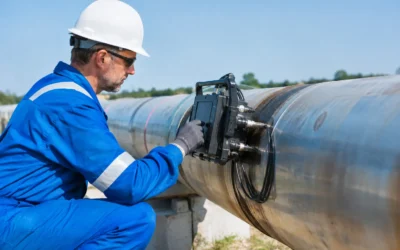

A data centre pipe failure example rarely begins with water visibly pouring across the white space. More often, it starts with a small pressure loss, a damp ceiling void, an unexplained rise in make-up water, or humidity that does not match the building management system trend. By the time water reaches racks, electrical rooms or critical plant, the incident has already become an uptime, asset protection and insurance problem.
Consider an illustrative scenario: a chilled-water branch line above a technical corridor develops a pinhole failure at a poorly supported joint. The line is insulated, concealed above a suspended ceiling and operating within a live facility. Water initially saturates insulation and ceiling materials rather than appearing at the point of failure. It then travels along the pipe route, emerges several metres away and begins affecting cable containment close to an equipment room.
The visible drip is not the origin. Treating it as the origin is how a controlled repair turns into repeated ceiling removal, extended diagnostics and unnecessary operational risk.
What this data centre pipe failure example shows
In a data centre, water is not merely a maintenance concern. It can compromise power distribution, cooling resilience, monitoring systems and the controlled environmental conditions on which IT equipment depends. Even where servers are not directly wetted, an uncontrolled leak can force isolation of cooling circuits, restrict access to technical areas and create condensation or corrosion risks that remain after the apparent leak has stopped.
In the scenario above, a facilities team may be tempted to remove the ceiling around the first wet patch and replace the visibly damaged section. That can work if the water source is local and obvious. It is a poor strategy when water has migrated from another point, when several pipe routes occupy the same void, or when the line has more than one defect.
The commercial consequences depend on the location and system involved. A leak on a low-risk domestic water branch is very different from a failure on chilled water, condenser water, fire protection, process water or a line serving critical cooling plant. The correct response therefore starts with identifying the system, confirming whether it is active, assessing immediate electrical exposure and controlling the risk without creating an unnecessary shutdown.
Why concealed leaks escalate quickly
Pipework in data centres is often routed through congested ceiling voids, risers, plantrooms and underfloor areas. Insulation can hold significant volumes of water and hide a developing failure. The water may follow gravity, vapour barriers, cable trays or structural elements before it becomes visible.
That movement creates a costly false lead. A repair team working only from the stain may open the wrong area, disturb functioning services and still fail to remove the actual defect. Meanwhile, the original leak continues to wet the structure.
Pressure and temperature cycles add another complication. A joint may only leak under particular operating conditions, such as when a chilled-water circuit is at peak load or when pumps change duty. A brief visual inspection during a quiet period can produce a misleading all-clear.
The likely causes behind the failure
The pinhole failure in this example could result from several mechanisms. Poor pipe support can place continuous strain on a joint. Inadequate insulation or vapour sealing may allow condensation to attack external surfaces. Water chemistry, corrosion, ageing flexible connections, vibration near pumps, defective valves and poor installation practices can also contribute.
The root cause matters because replacing one fitting without addressing the mechanism invites a repeat incident. If vibration has damaged a branch connection, the pipe supports and nearby connections require inspection. If corrosion is present, a broader condition assessment may be justified. If the failure follows recent fit-out work, accidental damage or altered loading should be investigated.
A technically credible incident report separates three questions: where is water emerging, where is the pipe defect, and why did that defect occur? They are not always the same answer.
Diagnosing the fault without widespread demolition
For a live data centre, diagnostics should be proportionate to risk and designed around operational continuity. The objective is not simply to find moisture. It is to pinpoint the active leak, confirm the affected pipework and give the repair team enough certainty to open the smallest practical area.
A methodical inspection commonly begins with system drawings, recent maintenance history, pressure records and a walk-through of the affected route. Engineers need to understand what sits above, below and adjacent to the wet area before testing begins.
Thermal imaging can identify anomalous temperature patterns associated with wet insulation, chilled-water leaks or moisture migration. It is particularly useful for mapping the spread of moisture, but it does not independently prove the exact hole in a pipe. Acoustic leak detection may help locate the sound created by water escaping under pressure, although performance depends on pipe material, background noise, insulation and flow conditions.
Pressure testing can establish whether an isolated section is losing integrity. In more complex cases, tracer gas testing provides a highly targeted way to identify a concealed escape point after the relevant line has been safely isolated and prepared. Moisture measurement, borescope inspection and visual checks within accessible voids can further reduce uncertainty.
No single tool is right for every incident. A large steel chilled-water line in a noisy plantroom may benefit from a different testing sequence than a small pressurised water line above a clean technical space. The strongest approach combines suitable methods, system knowledge and a clear decision on when isolation is justified.
Containment comes before repair speed
Speed matters, but an unplanned repair can create more risk than the leak itself. Before opening ceilings or cutting pipework, the site team should establish whether water can reach electrical containment, UPS rooms, switchgear, racks or low-level controls. Wet materials should be contained and drying should begin promptly to reduce mould growth and material deterioration.
If the leaking line is part of the cooling arrangement, isolation must be coordinated with the data centre’s redundancy design and current thermal load. Shutting down the wrong branch at the wrong moment can reduce cooling capacity below an acceptable margin. That decision belongs within the site’s operational and change-control process, not solely with the repair contractor.
Once the source is confirmed, repairs should include verification. The repaired section needs appropriate pressure testing, reinstatement of insulation and vapour barriers, moisture checks in the surrounding area and confirmation that alarms, temperatures and water trends have returned to normal. A patch without proof of integrity is not a completed incident response.
Turning one failure into a prevention programme
A pipe failure is also evidence about the condition of the wider asset. Not every isolated leak warrants a major investigation, particularly where a clear accidental cause exists. However, repeated water loss, recurring ceiling moisture, unexplained pressure drops or multiple failures on similar pipework should trigger a more structured assessment.
For facilities managers, useful prevention measures include condition-based inspections of high-risk routes, checks on pipe supports and insulation, targeted testing after refurbishment works, and review of water make-up and pressure trend data. Critical areas should also have clear escalation procedures for water alarms, including who can authorise isolation and who must be notified.
Continuous water monitoring and automatic shut-off technology can reduce the duration of a domestic or low-risk building leak. In data centre environments, automatic isolation requires more careful engineering because the consequences of stopping a process or cooling line can be significant. The principle is the same: detect abnormal behaviour early, but apply controls that suit the criticality of the system.
LeakDtech approaches complex failures with non-invasive testing first, then provides documented findings that support repair decisions, insurance discussions and future maintenance planning. The goal is not to produce a dramatic demolition programme. It is to locate the defect accurately, limit disruption and protect the facility’s operating margin.
The most valuable lesson from any data centre pipe failure is simple: investigate the first warning sign while it is still a diagnostic task, not after it has become an incident affecting equipment, cooling capacity and business continuity.