
A flooded doorway is rarely caused by a lack of effort. More often, water reaches the building before a practical defence has been deployed. The decision between reusable versus sandbag protection affects how quickly a homeowner, facilities team or property manager can respond, how much water is kept out, and what happens after the storm has passed.
For properties exposed to intense rainfall, surface-water run-off or drainage surcharge, the right answer is not always the cheapest barrier at the point of purchase. It is the system that protects the opening reliably, can be deployed by the people on site, and does not create an avoidable clean-up and repair bill.
Reusable versus sandbag protection: the core difference
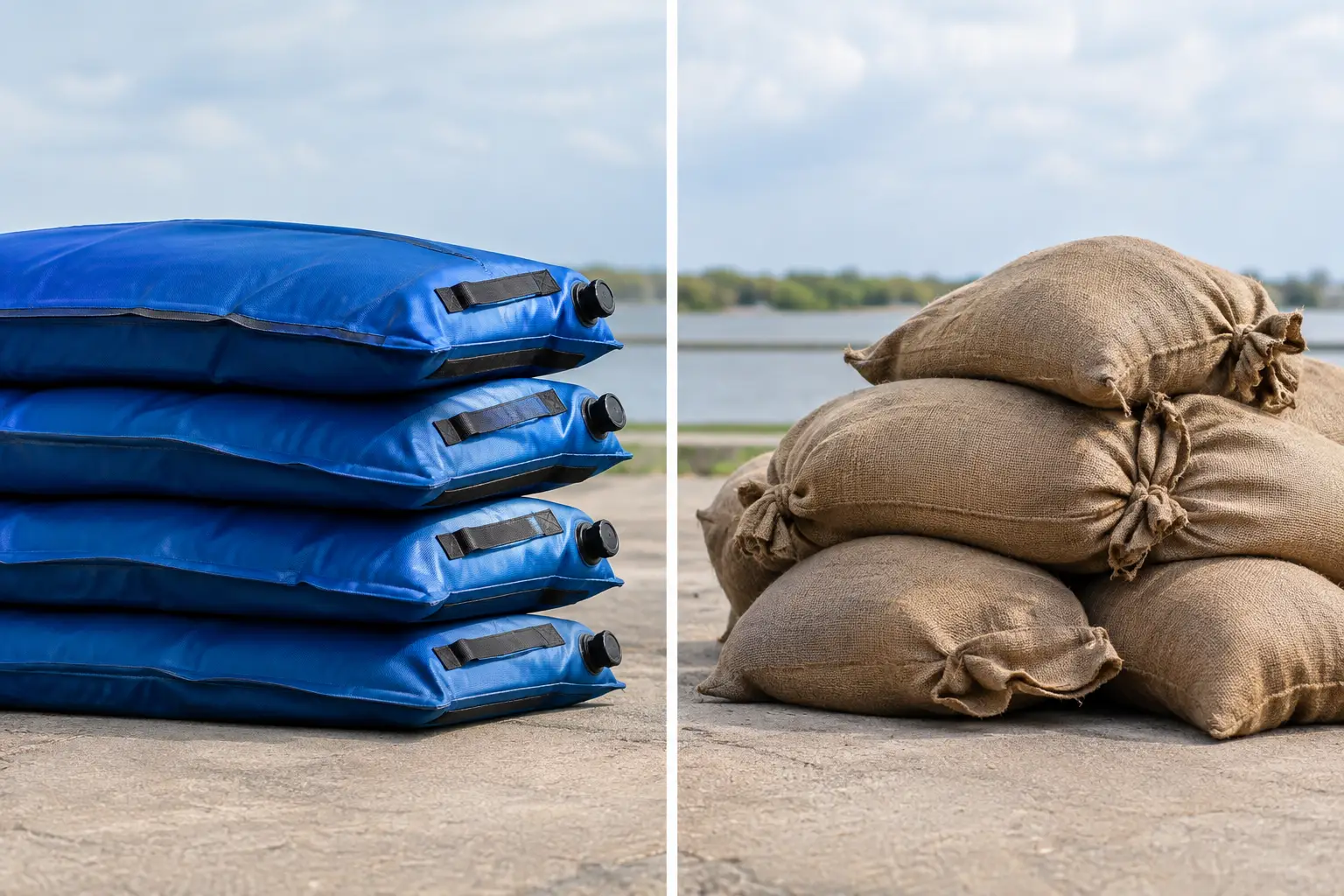
Sandbags are a traditional flood-control measure. Filled bags are stacked across an opening or around a vulnerable area to slow and divert water. They can be useful where the ground is uneven, the protected line is irregular, or a temporary bund is needed over a large outdoor area.
Reusable flood barriers are purpose-built panels or interlocking systems designed to seal across doors, gates and other defined openings. Their key advantage is repeatable installation. Once the correct barrier size has been selected, it can be fitted quickly without collecting sand, filling bags or building a wall from scratch.
Neither option makes a property invulnerable to every flood scenario. Water depth, flow speed, opening dimensions, drainage capacity and the condition of surrounding walls all matter. However, for a standard doorway or access opening, a properly fitted reusable barrier generally offers greater speed, consistency and cleanliness than sandbags.
Speed matters before water reaches the threshold
In Dubai, severe rain events can create fast-moving surface water with little warning. Building teams may be managing several entrances, basement ramps and service areas at once. A defence that requires filling, carrying and stacking dozens of bags can become difficult to organise when labour, sand or transport is unavailable.
Sandbags are also deceptively slow. A single bag may be easy to place, but an effective barrier normally needs multiple staggered layers. Bags must be filled to the right level, tied, transported and compacted into position. Gaps between bags are common, particularly where they meet a door frame, wall or uneven paving.
Reusable barriers are designed for a different operating reality. A correctly sized tool-free system can be deployed in minutes, allowing a caretaker, homeowner or security team to protect an opening before concentrating on drainage, pumps and other risk points. Dam Easy Flood Barriers, for example, are intended for rapid deployment at doors and openings without the labour-intensive preparation associated with sandbags.
That time saving is especially valuable for villas, ground-floor flats, retail units, schools and hospitality properties where water entering one access point can damage finishes, electrical systems, furniture and stored stock.
Sealing performance is not the same as water resistance
Sandbag walls do not create a watertight seal. Their purpose is usually to reduce the force and volume of incoming water, not to stop every drop. Water can seep through the bag material and through small channels between bags. A plastic sheet placed behind the bags may improve performance, but it adds another installation step and must be positioned correctly.
A reusable barrier typically relies on compression seals at the sides and base. When installed against a sound frame or prepared opening, this gives a far more controlled seal line. The result is less seepage at low to moderate water levels and more predictable performance from one event to the next.
The qualification is important: a high-quality barrier cannot compensate for a defective opening. Cracked thresholds, loose door frames, damaged render, unsealed cable penetrations and drains that back up behind the barrier can all allow water into the building. Flood protection should be checked as a system, not treated as a standalone product.
For commercial and managed properties, a pre-season inspection should identify each entry point, confirm barrier dimensions, and test whether doors, frames and surrounding surfaces remain suitable for sealing.
Labour, storage and post-flood clean-up
The practical cost of sandbags is often underestimated. Sand must be sourced and kept dry. Bags need space, manual handling and safe storage. After use, they may be saturated with dirty water, fuel residue, sewage or other contaminants. Disposal can become a health, housekeeping and waste-management issue.
Reusable barriers require storage too, but they are compact, cleanable and ready to use again. A property manager can assign each barrier to a specific doorway, label it clearly and include it in a storm-response procedure. This reduces dependence on emergency procurement and gives staff a clear action rather than an improvised task.
For homeowners, that simplicity is often the deciding factor. A barrier kept near the relevant door is more likely to be used in time than bags stored unfilled in a garage. For facilities teams, it means less manual handling and fewer people needed during an already pressured incident.
Cost should be measured over several weather events
Sandbags may appear inexpensive because individual bags and sand cost relatively little. That calculation changes when delivery, filling time, labour, disposal and repeat purchases are included. If a site needs regular protection during storm seasons, the ongoing operating cost can exceed the purchase price of a reusable system.
Reusable barriers have a higher upfront cost, particularly where several bespoke-width openings need protection. Yet they can offer better long-term value if they are used repeatedly, maintained properly and stored correctly. Their real financial benefit is often avoided damage: preventing water from reaching timber flooring, plasterboard, lifts, plant rooms, electrical equipment or tenant stock.
This does not mean sandbags have no place. They remain useful for temporary perimeter control, irregular outdoor areas, landscaping edges and locations where there is no solid frame for a rigid barrier. They are also a practical contingency where floodwater is expected across a wide, changing area rather than at one known opening.
The sensible approach is to match the defence to the failure point. Use reusable barriers for repeatable protection of defined doors and access points. Use sandbags where flexibility and ground shaping are more important than a clean seal.
Do not overlook drainage and hidden water routes
A flood barrier only protects the route it covers. If water is entering through a blocked gully, a failed basement drain, a damaged roof outlet or an overflowing external channel, protecting the front door may not address the actual problem.
Before the next rain event, inspect drainage grates, downpipes, patio falls and threshold drains. Remove debris, check that covers are secure, and look for settlement that directs water towards the building. Properties with recurring internal flooding should investigate whether the issue is surface run-off, a drainage restriction, plumbing failure or water penetrating through the building envelope.
Technical diagnosis becomes particularly valuable where the source is unclear. Non-invasive inspection methods can help establish why water is reaching a protected area, allowing owners to correct the root cause instead of repeatedly responding to the same damage.
Choosing the right protection for your property
Choose reusable barriers when you have known vulnerable openings, need fast deployment, want a cleaner solution and expect to use the protection more than once. They are well suited to villa doors, ground-floor entrances, retail frontages, service doors and managed buildings with trained site staff.
Choose sandbags when the flood line is irregular, the terrain is uneven, or you need to channel water across a wider outdoor area. They can also support a reusable-barrier plan by reinforcing low points around external landscaping or directing water away from the building.
The strongest flood plan often uses both, alongside maintained drainage and a clear response procedure. Assign responsibility, store equipment where it is needed, and practise deployment before the forecast turns severe. When water is approaching the threshold, preparation is worth far more than a last-minute scramble.